
Blog
Commercial Vessel Appraisal in Louisiana: What OSV, Tug, and Barge Owners Need
A commercial vessel appraisal in Louisiana values offshore supply vessels, tugs, barges, trawlers, and crew boats as income-producing assets, not pleasure craft. This guide explains when Gulf Coast operators need one, which valuation approach applies, and how USCG documentation shapes the appraiser's scope of work.
Louisiana's working waterfront runs on vessels that earn their keep: offshore supply vessels (OSVs) serving Gulf platforms, harbor and river tugs, deck barges, shrimp trawlers, and crew boats shuttling personnel to rigs. Appraising one of these assets is a different exercise than surveying a weekend cruiser. A commercial vessel appraisal has to account for earning capacity, regulatory documentation, and a thin resale market where every transaction detail matters. Our team at Louisiana Boat Appraisers prepares these appraisals for financing, insurance, litigation, and casualty matters across the state's ports and bayous, and this guide walks through how the process actually works.
What Makes a Commercial Vessel Appraisal Different From a Pleasure Craft Survey
A commercial vessel appraisal values an asset for its ability to generate income; a pleasure craft survey values a boat for personal use and typically leans on used-boat guides and retail comparables. That distinction changes almost everything about the assignment.
Income-producing vessels are valued on the amount of work they can perform, not on trim level or amenities. That might mean cargo or carrying capacity (tons, barrels, passengers) or performance metrics like horsepower, bollard pull, or lifting capacity, depending on the vessel's function. A tug's value hinges on its bollard pull and engine horsepower; a crew boat's value hinges on passenger capacity and speed; a barge's value hinges on deck space and load rating. None of that maps cleanly onto the condition-and-options checklist a surveyor uses on a recreational boat.
Comparable sales data is also harder to come by. Details on commercial vessel sales and offerings are usually limited to a vessel's major statistics, which makes adjusting comparables for age, class, and equipment far more judgment-intensive than pulling a retail price from a used-boat guide. If you're weighing whether your vessel needs a commercial appraisal or a standard marine survey, our boat appraisal guide for Louisiana owners walks through the recreational side of that decision in more depth.
Watch out: Don't assume a marine survey performed for insurance underwriting on a pleasure boat translates to a commercial vessel appraisal. The two documents answer different questions, use different data, and are rarely interchangeable for a lender, court, or tax authority.
When Do Louisiana Vessel Owners Need a Commercial Appraisal?
Most commercial vessel appraisals in Louisiana get triggered by one of six recurring situations, all common to the state's offshore energy and marine transport economy.
- Financing and refinancing: Lenders collateralizing an OSV, tug, or barge fleet want a defensible opinion of value before extending or renewing a loan.
- Insurance and hull value: Insurers and owners need an accurate hull and machinery value to set coverage limits and avoid being over- or under-insured.
- Litigation and marine casualty: Collisions, groundings, mechanical failures, or charter disputes often require an appraisal that can withstand cross-examination.
- Buy-sell transactions: A fleet acquisition or single-vessel sale needs a value opinion both sides can rely on, especially when the vessel is unique or lightly traded.
- Charter or lease negotiations: Setting a fair charter rate or lease value often starts with an appraisal of the underlying asset's earning potential.
- Estate, partnership, or dissolution matters: Vessels held by a partnership, LLC, or estate sometimes need a value opinion independent of the parties' interests.
Because our commercial vessel appraisals are scoped individually, there's no flat published fee the way there is for a small recreational boat. A single harbor tug is a very different assignment than a six-vessel OSV fleet with incomplete maintenance records, and the fee reflects that scope: vessel type and size class, number of vessels in the engagement, documentation quality, and whether the report needs to meet IRS-qualified or litigation-grade standards. Every engagement is quoted as a fixed fee before work begins, never billed hourly.
The Three Valuation Approaches for Income-Producing Vessels
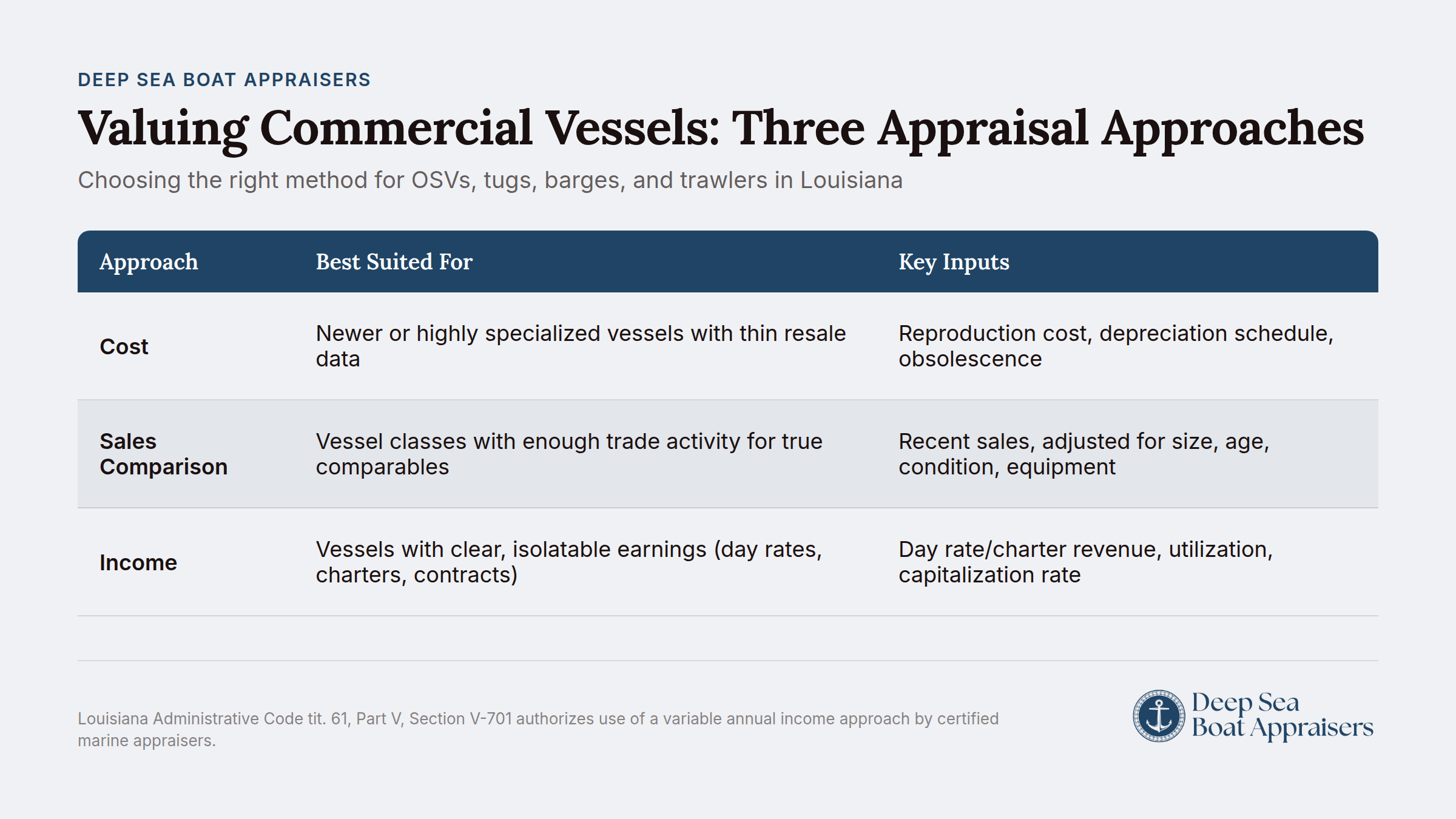
Commercial vessels are valued using the same three approaches applied across most machinery and equipment appraisal: cost, sales comparison, and income. Which approach carries the most weight depends on the vessel's age, market activity, and how directly its earnings can be isolated.
Cost Approach
The cost approach estimates what it would take to reproduce or replace the vessel new, then deducts depreciation for age, wear, and functional or economic obsolescence. This approach carries real weight for newer or highly specialized vessels where recent sales data is thin.
Louisiana's own property tax system leans heavily on a version of this approach: assessors valuing watercraft for ad valorem tax purposes start from reported cost, apply a cost index to bring it to current value, then depreciate based on the vessel's effective age, using standardized index, percent-good, and depreciation tables set out in the state regulations (Louisiana Administrative Code tit. 61, Part V, Section V-701). Those schedules assign different economic lives by vessel class, so a motor vessel and a crew boat, OSV, or utility vessel don't depreciate on the same timeline. An independent commercial vessel appraisal isn't a tax assessment, but the same cost-index-and-depreciation logic underlies both.
Sales Comparison Approach
This approach adjusts recent sales of similar vessels for differences in size, age, condition, and equipment. It's the most intuitive approach, but also the hardest to execute well for commercial vessels, because published sale details are typically limited to a vessel's headline statistics rather than a full condition and equipment breakdown. An appraiser working this approach has to lean on trade contacts, brokers, and industry data sources to fill in the gaps a simple listing won't show.
Income Approach
The income approach capitalizes the vessel's earning potential, whether that's day rates for an OSV or crew boat, charter revenue for a trawler, or towing contracts for a tug. Louisiana's own tax regulation explicitly recognizes this method for commercial vessels: assessors are authorized to weigh a variable annual income approach compiled by a certified marine appraisal firm to correlate current market conditions when standard cost tables don't capture a vessel's true earning power (Louisiana Administrative Code tit. 61, Part V, Section V-701).
| Approach | Best Suited For | Key Inputs |
|---|---|---|
| Cost | Newer or highly specialized vessels with thin resale data | Reproduction cost, depreciation schedule, obsolescence |
| Sales comparison | Vessel classes with enough trade activity to find true comparables | Recent sales, adjusted for size, age, condition, equipment |
| Income | Vessels with clear, isolatable earnings (day rates, charters, contracts) | Day rate or charter revenue, utilization, capitalization rate |
Why USCG Documentation and Title 46 CFR Regulations Matter to the Scope of Work
A commercial vessel's regulatory standing directly affects its value, which is why USCG documentation belongs in the appraiser's scope of work from day one. The status of a vessel's Certificate of Inspection (COI) and its compliance posture under Title 46 of the Code of Federal Regulations is a measure of economic obsolescence, not just paperwork. A vessel with a lapsed COI, an expired load line certificate, or an open Coast Guard deficiency may be worth meaningfully less than an identical vessel with clean documentation, because that gap affects the vessel's ability to earn until it's resolved.
Working vessels are subject to periodic Coast Guard inspection, and current survey and certification status is commonly required for both insurance coverage and vessel financing. An appraiser has to confirm documentation status as part of the physical inspection, because a buyer, lender, or court will ask the same question the appraiser should already have answered.
Pro tip: Before your vessel is inspected, pull together your current COI, most recent classification society survey, and any open deficiency list. It shortens the inspection and gives the appraiser the documentation trail needed to support the value conclusion.
How Louisiana Regulates Appraisers and Vessel Valuation
Louisiana doesn't license marine vessel appraisers as a standalone category, but two areas of state law shape who performs appraisals tied to commercial vessels and how those appraisals get used.
For property insurance disputes, including damage claims involving insured commercial vessels, Louisiana's insurance code establishes a formal appraisal process with defined roles for the appraiser, the claimant, and an umpire who resolves disagreements between appraisers (Louisiana Revised Statutes Title 22, appraisal process provisions). Appraisers who participate in that process must meet state qualification standards and register with the Louisiana Department of Insurance, disclosing their training, experience with property damage claims, and whether that experience covers residential or commercial property (Louisiana Revised Statutes 22:1807.15, appraiser registration requirements).
On the tax side, most commercial vessels with Louisiana situs are taxed as watercraft under the ad valorem property tax system, valued at fair market value as of January 1 each year by the parish assessor, with narrow exemptions for gasoline-powered vessels and vessels used in fisheries for human consumption (Louisiana Administrative Code tit. 61, Part V, Section V-701).
Key takeaway: An independent commercial vessel appraisal serves a different purpose than a tax assessment or an insurance-appraisal-process filing, but all three draw on the same underlying valuation logic: cost, market comparison, and income, adjusted for a vessel's regulatory and documentation status.
What to Expect During the Physical Inspection and Report
A credentialed marine appraiser's inspection goes well beyond a walk-around. Because condition drives so much of a commercial vessel's remaining value, the appraiser needs working knowledge of the vessel's hull material, whether steel, aluminum, fiberglass, or wood, along with the construction and classification standards that govern that vessel type.
During the inspection, expect the appraiser to review and document:
- Hull and structural condition: Visual inspection supplemented by nondestructive testing tools where warranted, along with any classification society survey history.
- Machinery and systems: Main engines, generators, deck machinery, and any specialized equipment tied to the vessel's function (winches, cranes, pumps).
- Regulatory documentation: Current COI, load line certificate, classification society status, and any open deficiencies noted by the Coast Guard.
- Operating history: Utilization records, day rates or charter history, maintenance logs, and permit status, all of which speak to both value and obsolescence.
- Comparable market data: Recent sales or charter activity for similar vessel classes, adjusted for the differences that a simple sales listing won't disclose.
Our marine appraisers hold credentials with organizations including the ASA and follow USPAP (the Uniform Standards of Professional Appraisal Practice) in preparing every report, alongside the specialized marine surveying credentials common in the industry. The final report ties the physical inspection, documentation review, and market analysis together into a single, defensible value conclusion, built for whichever audience will read it: a lender's credit committee, an insurer, opposing counsel, or a judge.
Getting a Defensible Value for Your Commercial Vessel
A commercial vessel appraisal in Louisiana has to do more work than a recreational boat survey. It has to hold up in front of a lender, an insurer, opposing counsel, or a tax authority, and it has to account for earning capacity and regulatory status in a market where comparable sales data is often thin. Getting the scope of work right from the start, including documentation, inspection depth, and the right blend of cost, sales comparison, and income analysis, is what makes the difference between an appraisal that gets questioned and one that gets accepted.
If you own or operate an OSV, tug, barge, trawler, or crew boat anywhere along Louisiana's coast or inland waterways, our team can scope your appraisal around the purpose you need it for. Request an appraisal to start the conversation about your vessel, your timeline, and what the report needs to accomplish.
This article is provided for general informational purposes only and does not constitute legal, tax, or financial advice. Readers should consult a qualified attorney or CPA regarding their specific circumstances.