
Blog
Boat Appraisal Louisiana: How to Get Your Marine Vessel Professionally Valued
Louisiana boat owners need a formal appraisal for insurance claims, hurricane casualty losses, charitable donations, and succession or divorce matters, and that process is entirely separate from LDWF titling and registration. Here's when you need one, what it costs, and exactly how to get it done.
A boat appraisal in Louisiana answers a question that registration paperwork never touches: what is this vessel actually worth. Whether you're settling an insurance claim after a storm, filing a casualty loss with the IRS, dividing property in a divorce, or donating a boat to a nonprofit, you need a documented, defensible value, not just a hull number on file with the state. This guide walks through when Louisiana boat owners actually need a formal appraisal, how it differs from state titling, and the steps involved in getting one done through our Louisiana boat appraisal team.
When Does a Louisiana Boat Owner Need a Formal Appraisal?
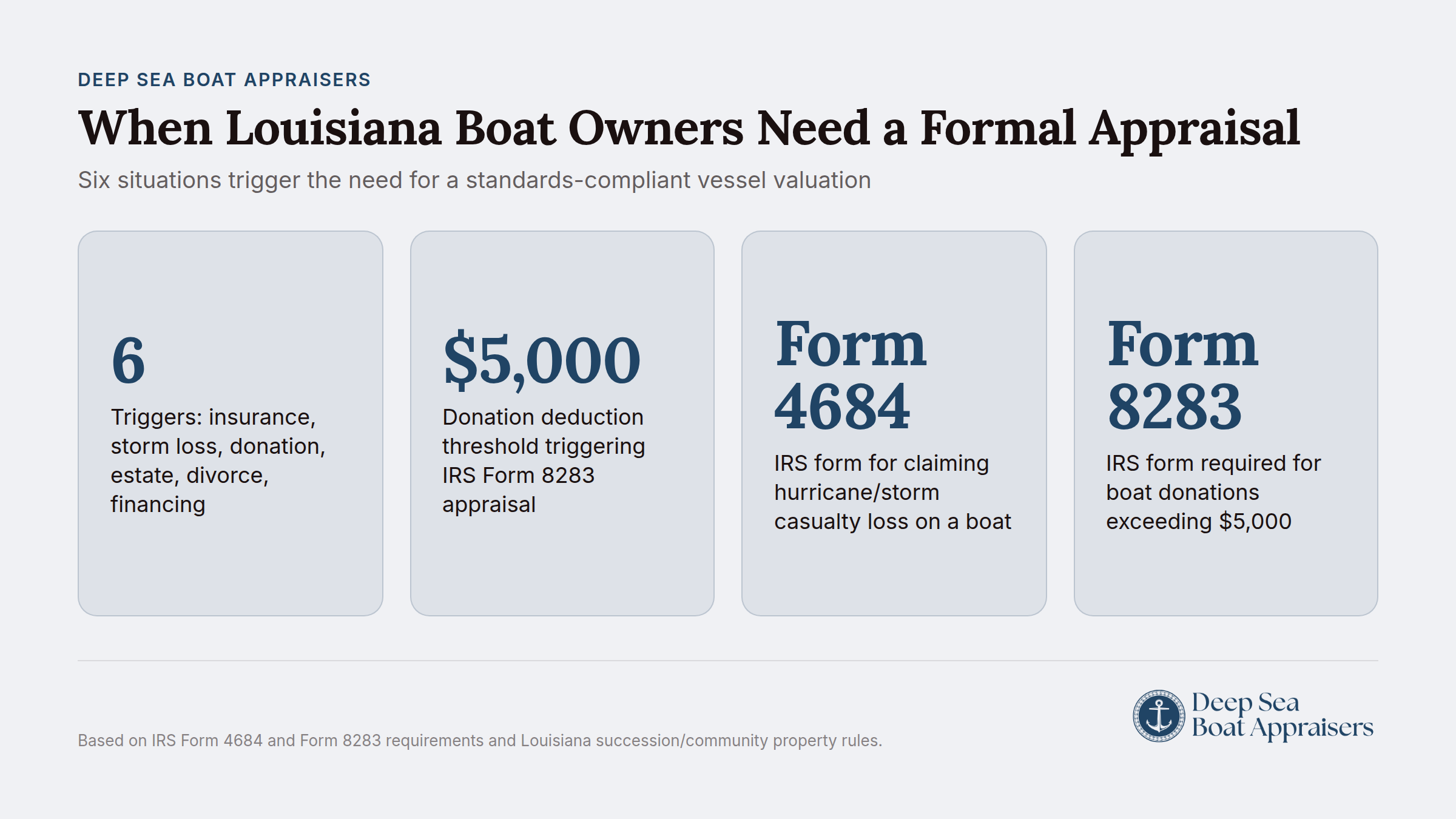
A formal appraisal becomes necessary any time a third party, whether that's the IRS, an insurer, a court, or a lender, needs a documented, standards-compliant value rather than your own estimate. Louisiana boat owners most commonly need one for the following situations:
- Insurance claims and total loss disputes: When an insurer's settlement offer seems low, an independent appraisal gives you a defensible counter-value backed by market data rather than a policy-side estimate.
- Hurricane and storm casualty loss (IRS Form 4684): Gulf Coast storms regularly damage or destroy vessels moored in Louisiana marinas, and claiming a casualty loss deduction requires documenting the boat's value immediately before and after the event.
- Charitable donation over $5,000 (IRS Form 8283): Donating a boat to a qualifying organization triggers a qualified appraisal requirement once the claimed deduction exceeds $5,000.
- Estate and succession matters: Louisiana's succession process requires an inventory of the decedent's assets, and a boat is often one of the larger tangible items that needs a documented value.
- Divorce and community property division: Boats acquired during a marriage are typically treated as community property in Louisiana, and both spouses' attorneys generally want an independent value before dividing marital assets.
- Financing and pre-purchase decisions: Lenders financing a vessel purchase, and buyers negotiating a private sale, both benefit from a value that isn't tied to either party's interest in the outcome.
Each of these situations has a different intended use, and the appraisal report has to be scoped for that use from the outset.
Registration and Titling Aren't the Same as an Appraisal
Registering a boat with the state and having it appraised are two completely separate processes, and confusing them is one of the most common mistakes Louisiana boat owners make. The Louisiana Department of Wildlife and Fisheries requires registration for every motorized vessel and every sailboat 12 feet or longer used on the state's public waters, and every registered motorboat, houseboat, or sailboat must carry a number.
That registration fee, however, is based purely on length class, not on the vessel's value. Louisiana's statutory fee schedule sets flat fees for a three-year registration term regardless of what the boat is actually worth:
| Coast Guard Class | Length | Registration Fee |
|---|---|---|
| Class A | Under 16 ft | $36 |
| Class 1 | 16 to under 26 ft | $57 |
| Class 2 | 26 to under 40 ft | $78 |
| Class 3 | 40 ft and over | $99 |
These figures come from Louisiana's statutory registration fee schedule. Nothing about that schedule tells you what your boat is worth for insurance, tax, or estate purposes. Louisiana does recognize a formal fair market value standard for watercraft, but it appears in a different context entirely: the state's property tax rules direct parish assessors to determine fair market value of taxable watercraft as of January 1 each year, using cost tables and depreciation schedules built specifically for vessels. That framework confirms Louisiana treats boat valuation as a distinct, structured exercise, separate from the registration desk.
Marine Survey vs. Fair Market Value Appraisal: What's the Difference?
A marine survey and a fair market value appraisal answer two different questions, and Louisiana boat owners often need only one of them, not both. A marine survey is a condition-focused inspection: a surveyor examines the hull, mechanical systems, rigging, and safety equipment, typically checking against American Boat and Yacht Council and National Fire Protection Association standards, and reports on seaworthiness and needed repairs. Insurers and lenders frequently require a current marine survey before binding a policy or approving financing, because their concern is risk, not value.
A fair market value appraisal, by contrast, answers what the vessel is worth on the open market as of a specific date, using recognized valuation approaches: comparing recent sales of similar vessels, applying cost and depreciation analysis, and for income-producing commercial craft, weighing income potential. This is the report the IRS wants for a casualty loss or charitable donation, the report a succession representative needs for an estate inventory, and the report attorneys request when dividing community property in a divorce.
| Marine Survey | Fair Market Value Appraisal | |
|---|---|---|
| Focus | Physical condition and seaworthiness | Market value as of a specific date |
| Who typically requires it | Insurers, lenders | IRS, courts, estates, donees |
| Typical inspection | On-site, hands-on | Often desktop or online, depending on purpose |
| Standard followed | ABYC/NFPA condition guidelines | USPAP (Uniform Standards of Professional Appraisal Practice) |
Do You Need a Marine Survey for Every Appraisal Assignment?
No. Whether a marine survey is required depends entirely on the appraisal's intended use, not on the fact that it's a boat. An insurance or financing appraisal usually calls for an on-site inspection because the insurer or lender needs current condition data tied to the value conclusion. An estate or succession appraisal, on the other hand, is frequently scoped as an online, desktop valuation: the appraiser reviews photographs, documentation, comparable sales, and the vessel's history to reach a defensible fair market value without a physical survey, since the intended use is a value opinion for tax or distribution purposes rather than a risk assessment.
Watch out: Don't assume every boat appraisal requires a surveyor to climb into the bilge. Ask what the assignment is for first, then scope the inspection to match. Our FAQs page walks through more of these scoping questions if you're not sure which type of report your situation calls for.
How to Get a Boat Appraised in Louisiana
- Determine the Purpose of Your Appraisal
- Insurance claim, casualty loss, charitable donation, estate, divorce, or financing all call for slightly different report scopes and, in some cases, an IRS-qualified appraisal versus a standard report.
- Gather Your Vessel's Documentation
- Pull together your Hull Identification Number, current LDWF registration, prior surveys, purchase records, and any storm or damage photos if the appraisal relates to a casualty loss.
- Decide Whether You Need an On-Site Survey or a Desktop Valuation
- If an insurer or lender is involved, plan for an on-site inspection. If the assignment is for an estate, succession, or donation, an online valuation is often sufficient.
- Request Your Appraisal
- Submit the details of your vessel and the purpose of the report through our appraisal request page, and we'll scope the assignment and quote a fixed fee before any work begins.
- Receive Your USPAP-Compliant Report
- The finished report documents methodology, comparable data, and a supported conclusion of value, formatted for the intended use, whether that's an insurer, the IRS, a court, or a lender.
For boats, engagements are typically quoted as a Standard report starting from $195 or an Advanced, IRS-qualified report starting from $295, with most assignments falling between $195 and $495 depending on the vessel's complexity and documentation. Larger or more complex vessels, including custom or commercial craft, can run from $1,800 to $4,500 or more. Every fee is a fixed amount agreed on after we understand the scope, never billed hourly.
Hurricane Casualty Loss and IRS Filings
Gulf Coast storms are a recurring reality for Louisiana boat owners, and a damaged or destroyed vessel can qualify for a casualty loss deduction. Claiming that deduction on IRS Form 4684 requires documenting the vessel's fair market value immediately before the casualty and immediately after, and the difference between those two figures, capped at your adjusted basis, generally forms the deductible loss.
The same qualified-appraisal framework applies on the donation side: if you're donating a boat to a qualifying charity and claiming a deduction over $5,000, the IRS requires a qualified appraisal reported on Form 8283. Both filings depend on a well-documented, dated valuation, which is exactly why a desktop fair market value appraisal, prepared before storm season or shortly after a casualty event, is worth having on file rather than reconstructed after the fact.
Estate, Succession, and Divorce: Valuing a Boat as Community Property
Boats acquired during a marriage are generally treated as community property under Louisiana law, meaning both spouses typically hold an interest that has to be accounted for in a divorce settlement. An independent fair market value appraisal gives both parties, and their attorneys, a neutral number to work from instead of dueling estimates.
The same logic applies in a succession. Louisiana's succession process requires an inventory of the decedent's property, and a boat, particularly a larger vessel, is often significant enough that heirs and the succession representative want a defensible value rather than a guess. Because these assignments are about establishing value for tax and distribution purposes rather than assessing seaworthiness, they're frequently well suited to an online, desktop appraisal.
Credentials to Look for in a Louisiana Boat Appraiser
Not every appraiser is equipped to value marine assets, and the credentials matter more here than with most personal property. Look for appraisers whose team holds credentials such as the American Society of Appraisers (ASA), the Certified Appraisers Guild of America (CAGA), and, for condition-focused inspections, the National Association of Marine Surveyors (NAMS). Every report, regardless of credential background, should be prepared in accordance with USPAP, the standard published by The Appraisal Foundation and followed across the appraisal profession.
Pro tip: If your assignment involves both a value opinion and a condition inspection, such as a pre-purchase decision on an older vessel, ask whether the same engagement can cover both, or whether you'll need to coordinate a separate marine survey alongside the appraisal.
Getting Your Vessel Valued the Right Way
A boat appraisal in Louisiana isn't a formality tacked onto registration, it's a separate, purpose-built report that has to match whatever's driving the need: a storm claim, an IRS filing, a divorce, a succession, or a purchase decision. Getting the scope right from the start, and matching the report to the standard the reviewing party actually expects, saves time and protects the value you're trying to document. Our team scopes each Louisiana boat appraisal around its intended use and delivers a USPAP-compliant report built for that purpose.
This article is provided for general informational purposes only and does not constitute legal, tax, or financial advice. Readers should consult a qualified attorney or CPA regarding their specific circumstances.