
Blog
Louisiana Boat Insurance Claims for Hurricane Damage: How Appraisers Prove Pre-Loss Value
A Louisiana boat insurance claim for hurricane damage lives or dies on pre-loss value evidence. Here's how agreed value and actual cash value policies pay out differently, what documentation an appraiser needs, and how Louisiana's proof-of-loss deadline works.
Hurricane season turns Louisiana's boat owners into insurance claimants almost every year, and the hardest part of a storm claim is rarely proving the boat was damaged. It's proving what the boat was worth the moment before the water came up. This article covers why hurricane and flood risk create pre-loss value disputes, how agreed value and actual cash value policies pay a total loss differently, what proof-of-loss documentation actually holds up, and how Louisiana's proof-of-loss deadline works after a declared disaster.
Why Hurricane and Flood Risk Drive Pre-Loss Value Disputes
When a named storm surges through a marina, a dock, or a backyard boat lift, the vessel that comes out the other side often looks nothing like the one that went in. Salt water intrusion, submerged engines, hull punctures from floating debris, and total losses where the boat simply disappears all leave the insurer and owner arguing over the same question: what was this boat actually worth right before the storm?
That argument exists because Louisiana boats rarely carry the kind of dated, third-party valuation that a home carries through a mortgage appraisal. Most owners have a purchase invoice, maybe a loan payoff figure, and a rough sense of what similar boats sell for. Insurers, meanwhile, lean on generic pricing guides that don't account for upgrades, engine hours, or the specific market for that hull in southeast Louisiana. Louisiana law gives both sides a formal path when they can't agree: the statutory appraisal process lets each party choose an independent appraiser, and if those two can't agree, an umpire settles the amount of loss. That process only works well when someone shows up with a defensible, well-documented pre-loss value opinion rather than a guess.
A pre-loss marine survey or appraisal is the single strongest piece of evidence an owner can hand an adjuster or appraiser after a storm. It fixes the boat's condition, equipment list, and fair market value at a specific date, months or years before the hurricane, which removes most of the guesswork from the claim.
Agreed Value vs Actual Cash Value: How Each Pays a Total Loss
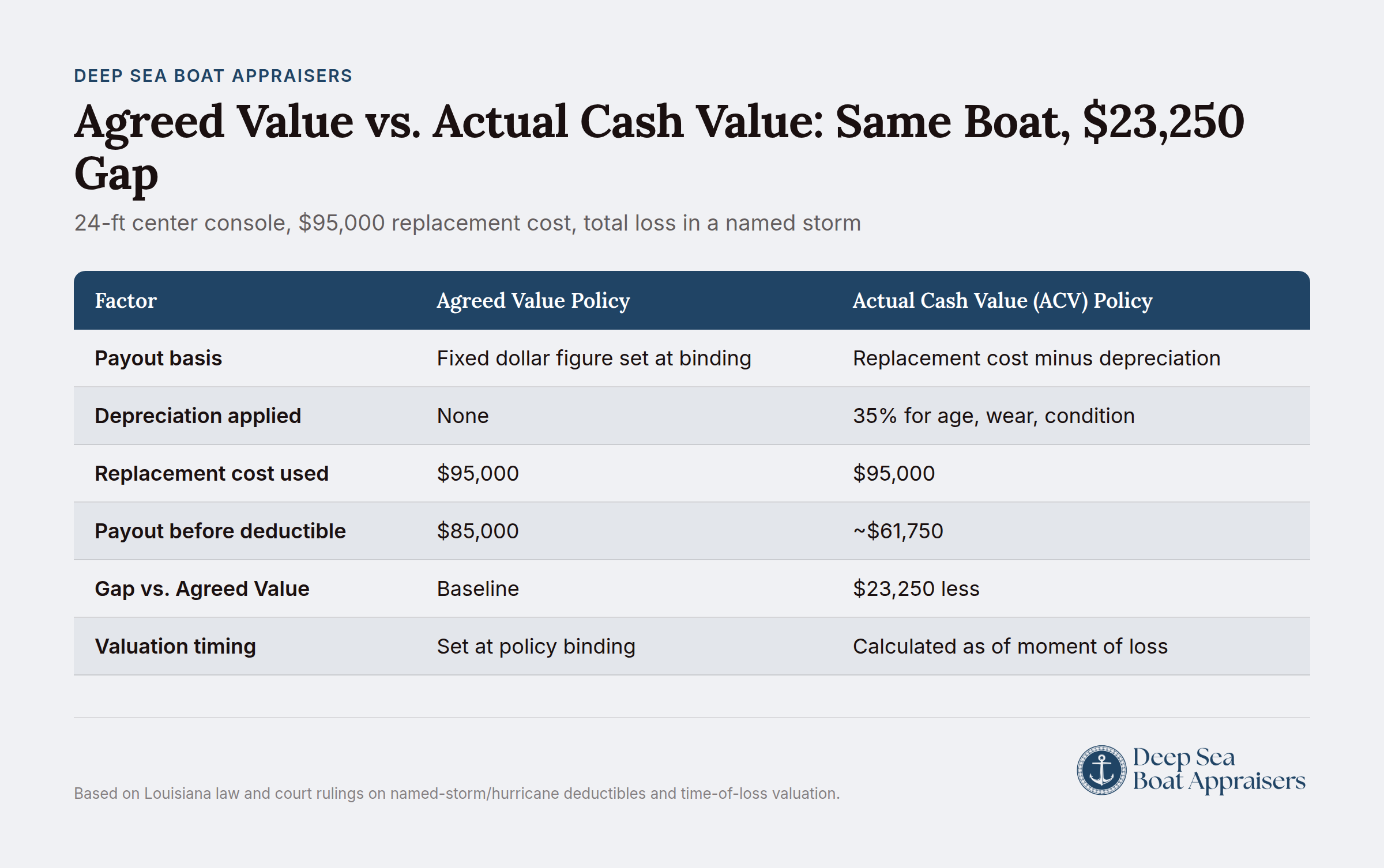
The policy type determines the entire payout math, and most boat owners never read this clause until they need it. An agreed value policy sets a fixed dollar figure at binding that the insurer pays on a total loss, no depreciation applied. An actual cash value (ACV) policy pays replacement cost minus depreciation for age, wear, and condition, calculated as of the moment of loss.
Example: A 24-foot center console with a diesel-comparable replacement cost of $95,000 suffers a total loss in a named storm. Under an agreed value policy written at $85,000, the owner receives $85,000 minus the applicable deductible. Under an ACV policy, an appraiser applies 35% depreciation for the boat's age and prior wear, bringing the payout basis to roughly $61,750 before the deductible is subtracted. The same boat, two different policy structures, and a $23,250 gap in what the owner collects.
Louisiana law recognizes separate hurricane and named-storm deductibles that can be expressed as either a flat dollar figure or a percentage of the insured value, and courts have confirmed that both replacement cost and actual cash value are calculated as of the time of loss, not the time of the claim filing or settlement. That timing detail matters because it forces the appraiser to reconstruct the boat's condition on the day before the storm, not its condition after months of saltwater damage and delayed repairs.
Pro tip: If your policy doesn't say "agreed value" in plain language, assume it pays actual cash value. Ask your agent directly and get the answer in writing before hurricane season, not after.
What Proof-of-Loss Documentation Louisiana Boat Owners Need
An insurer or umpire wants to see a paper trail that predates the storm, not a story that starts the week the claim was filed. Solid proof-of-loss documentation for a Louisiana boat claim includes:
- Dated photographs of the hull, deck, engine compartment, electronics, and any recent upgrades, taken before hurricane season if possible
- Maintenance and repair records, including engine service logs, haul-out reports, and any bottom paint or gelcoat work
- Purchase receipts and upgrade invoices for electronics, engines, trailers, and rigging added after the original purchase
- An itemized inventory of onboard equipment, safety gear, and accessories, since generic pricing guides rarely price these separately
- A prior marine survey or appraisal report, which is the single most persuasive document an appraiser can build from after a loss
Watch out: Insurers and umpires discount claims that rely only on memory and post-loss photos. Pre-existing wear, prior damage, and deferred maintenance all have to be distinguished from storm damage, and that distinction is nearly impossible to make credibly without dated records from before the hurricane. Standard marine survey practice calls for exactly this kind of documentation trail, including hull identification numbers, registration records, and prior survey history, before any valuation opinion is offered.
Our boat value FAQ walks through the comparable-sales and condition adjustments an appraiser applies once that documentation is in hand.
Louisiana's 180-Day Proof-of-Loss Window After a Declared Disaster
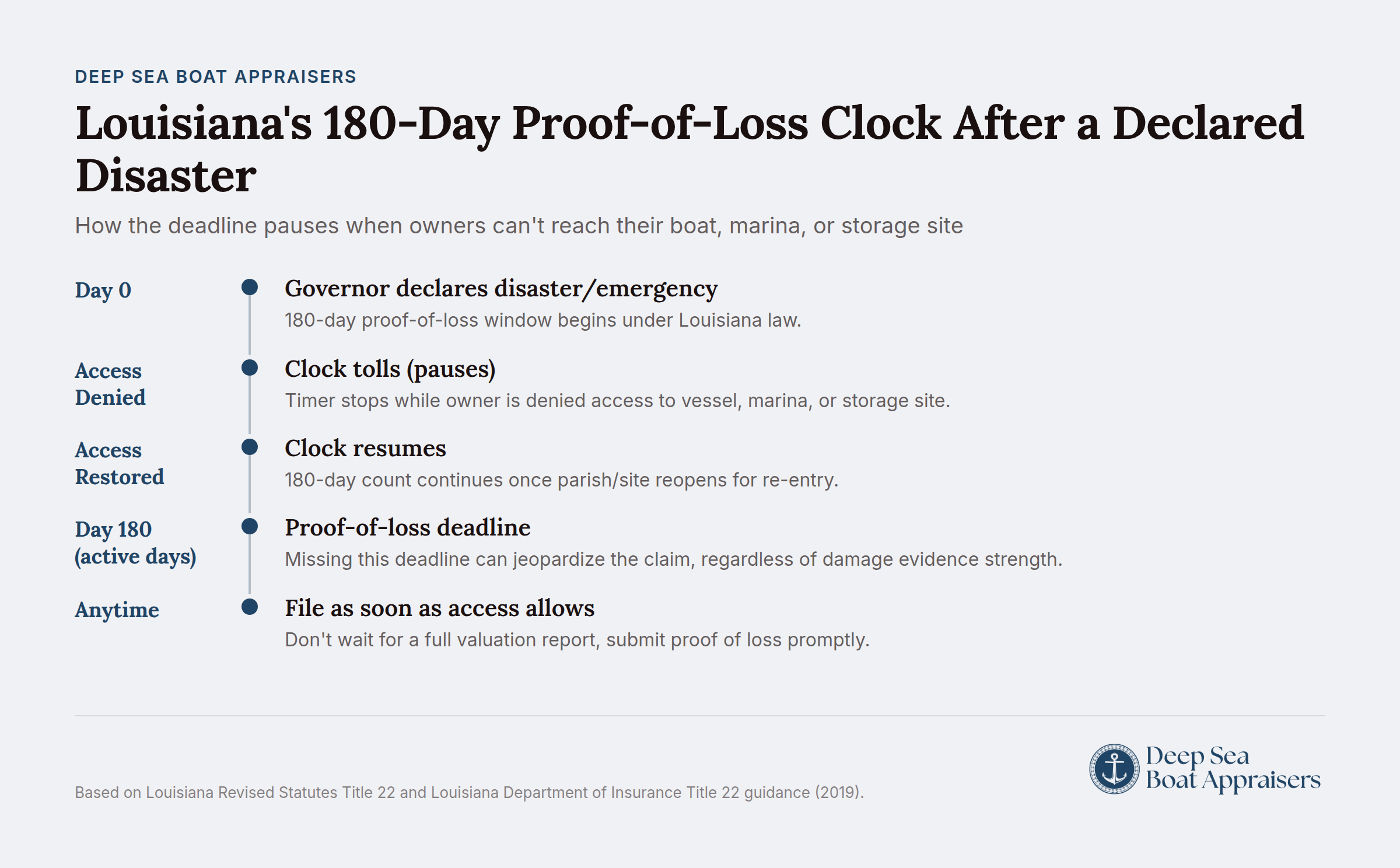
Louisiana extends the standard proof-of-loss deadline to 180 days following a gubernatorially declared disaster or emergency, and that clock stops running while the owner is denied access to the vessel, the marina, or the storage site. This tolling provision matters enormously in a state where entire parishes can be closed to re-entry for weeks after a hurricane.
The Louisiana Department of Insurance publishes guidance clarifying how these disaster-related deadlines interact with standard policy provisions, and the underlying replacement-cost and claims-handling rules sit in Title 22 of the Louisiana Revised Statutes. The Louisiana Department of Insurance's compiled Title 22 guidance is the reference document adjusters and appraisers use to confirm exactly when that 180-day window starts and stops for a given disaster declaration.
Key takeaway: Missing the proof-of-loss deadline can jeopardize a claim regardless of how strong the underlying damage evidence is, so owners should file as soon as access is restored rather than waiting for a full valuation report to be finished.
Reconstructing Pre-Loss Value When No Prior Appraisal Exists
Most boat owners don't have a pre-storm appraisal sitting in a drawer, and that's the reality our appraisers work with on the majority of Louisiana hurricane claims. When no prior survey exists, we reconstruct pre-loss fair market value using multiple independent data sources rather than a single pricing guide: J.D. Power Marine (the pricing service formerly published as NADA Marine), the ABOS Marine Blue Book, and actual closed-sale data from BoatWizard's SoldBoats database. Cross-referencing these sources against the boat's documented equipment, engine hours, and condition at the time of loss produces a value opinion that can withstand scrutiny from an insurer, an umpire, or opposing counsel.
A federal appellate ruling touching on Louisiana property valuation reinforced that both replacement cost and actual cash value are fixed as of the date of loss, which is exactly the standard our reconstructions are built to meet even when the original documentation is thin. The stronger the pre-loss records an owner can supply, whether that's a full marine survey or a handful of dated maintenance receipts, the tighter and more defensible that reconstructed value becomes.
Getting the Documentation Right Before the Next Storm
Hurricane and flood claims on Louisiana boats are won or lost on the strength of pre-loss value evidence, not on the severity of the damage photos alone. Owners who commission a marine survey or appraisal before hurricane season, keep dated maintenance and upgrade records, and understand whether their policy pays agreed value or actual cash value put themselves in a dramatically stronger position when a named storm forces a claim. If you're heading into hurricane season without a current valuation on file, or you're already navigating a claim and need pre-loss value reconstructed, request an appraisal from our team before the proof-of-loss clock runs out.
This article is provided for general informational purposes only and does not constitute legal, tax, or financial advice. Readers should consult a qualified attorney or their insurance carrier regarding their specific circumstances.