
Blog
Louisiana's New Boat Sales Tax Cap Under Act 11: What Owners Must Know
Louisiana's new boat sales tax cap limits combined state and local tax on a registered vessel to $20,000, but only if you pay within 90 days and meet a handful of conditions under Act 11. Here is how the cap works, what Form R-1331 requires, and why a documented appraisal matters for boats brought in from out of state.
Louisiana boat owners registering a vessel after July 1, 2025 are now subject to a new sales and use tax cap that can meaningfully change what comes due at the counter. Act 11 of the 2025 Third Extraordinary Session limits combined state and local tax on a qualifying boat to $20,000, but the cap only applies if you meet specific timing and documentation requirements. This guide breaks down how the cap works, what the Louisiana Department of Wildlife and Fisheries requires before it issues a registration certificate, and why a documented boat appraisal becomes directly relevant when a boat is brought into Louisiana from another state.
What Is the Louisiana Boat Sales Tax Cap?
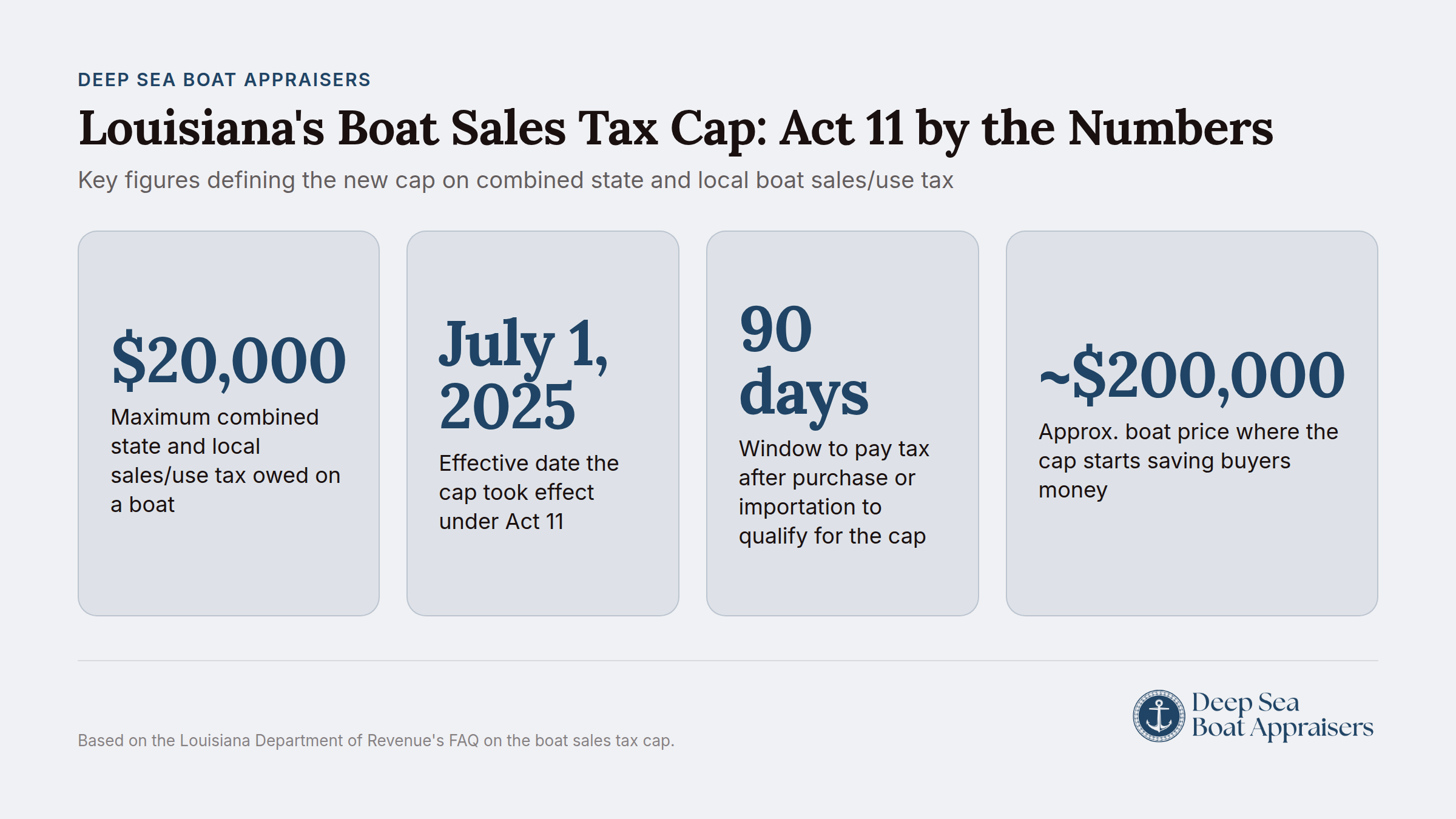
The Louisiana boat sales tax cap limits the combined state and local sales and use tax owed on a boat registered in Louisiana to $20,000, as long as the tax is paid within 90 days of purchase or importation. The cap took effect July 1, 2025 under Act 11 and applies after any credit for tax already paid to another state, according to the Louisiana Department of Revenue's FAQ on the cap.
Before Act 11, Louisiana taxed boat purchases as a straight percentage of price, with no ceiling. A $2 million yacht and a $40,000 fishing boat were taxed at the same combined rate, roughly 10% between state and local jurisdictions. The new cap changes that math dramatically for high-value boats, while leaving the rules unchanged for boats priced well under the breakeven point.
How Act 11 Changed Boat Registration Tax in Louisiana
Act 11 amended Louisiana's sales and use tax statutes as part of a broader 2025 tax reform package, and the boat provision now lives in La. R.S. 47:305.23. The statute caps combined state and local tax on boats registered in Louisiana, splits the capped amount between state and local authorities, and sets conditions that must be met before a taxpayer can rely on the cap.
The two conditions that matter most for owners are straightforward:
- Registration timing: the boat must be registered in Louisiana on or after July 1, 2025 for the cap to apply.
- Payment timing: the tax must be paid within 90 days of purchase or, for a boat brought into Louisiana from elsewhere, within 90 days of importation.
Miss either window and the cap simply does not apply. Tax would then be calculated the old way: a flat percentage of the taxable price, with no $20,000 ceiling.
Who Actually Benefits From the $20,000 Cap?
Because Louisiana's combined state and local sales tax rate runs around 10% in most parishes, the cap only changes the outcome for boats priced above roughly $200,000. Below that threshold, a boat owner would have owed less than $20,000 in tax anyway, so the cap has no practical effect.
Example: A boat purchased for $500,000 would ordinarily generate about $50,000 in combined state and local tax at a 10% rate. Under the cap, and assuming the owner registers the boat in Louisiana after July 1, 2025 and pays within 90 days, the tax owed is limited to $20,000 instead.
Public reporting on the law notes that the cap was written with recreational and charter or fishing tour vessels in mind, and that it does not add any new benefit for commercial shrimping and fishing vessels, which already qualify for a full sales tax exemption under existing Louisiana law, as reported by Business Report.
Watch out: Buying loose accessories or a separate trailer does not increase the taxable price used to calculate whether the cap applies. Only equipment attached to the boat at the time of purchase counts toward the taxable sales price; trailers, gas cans, life jackets, and similar gear are excluded from that calculation.
Registering Your Boat: Form R-1331 and the Department of Wildlife and Fisheries
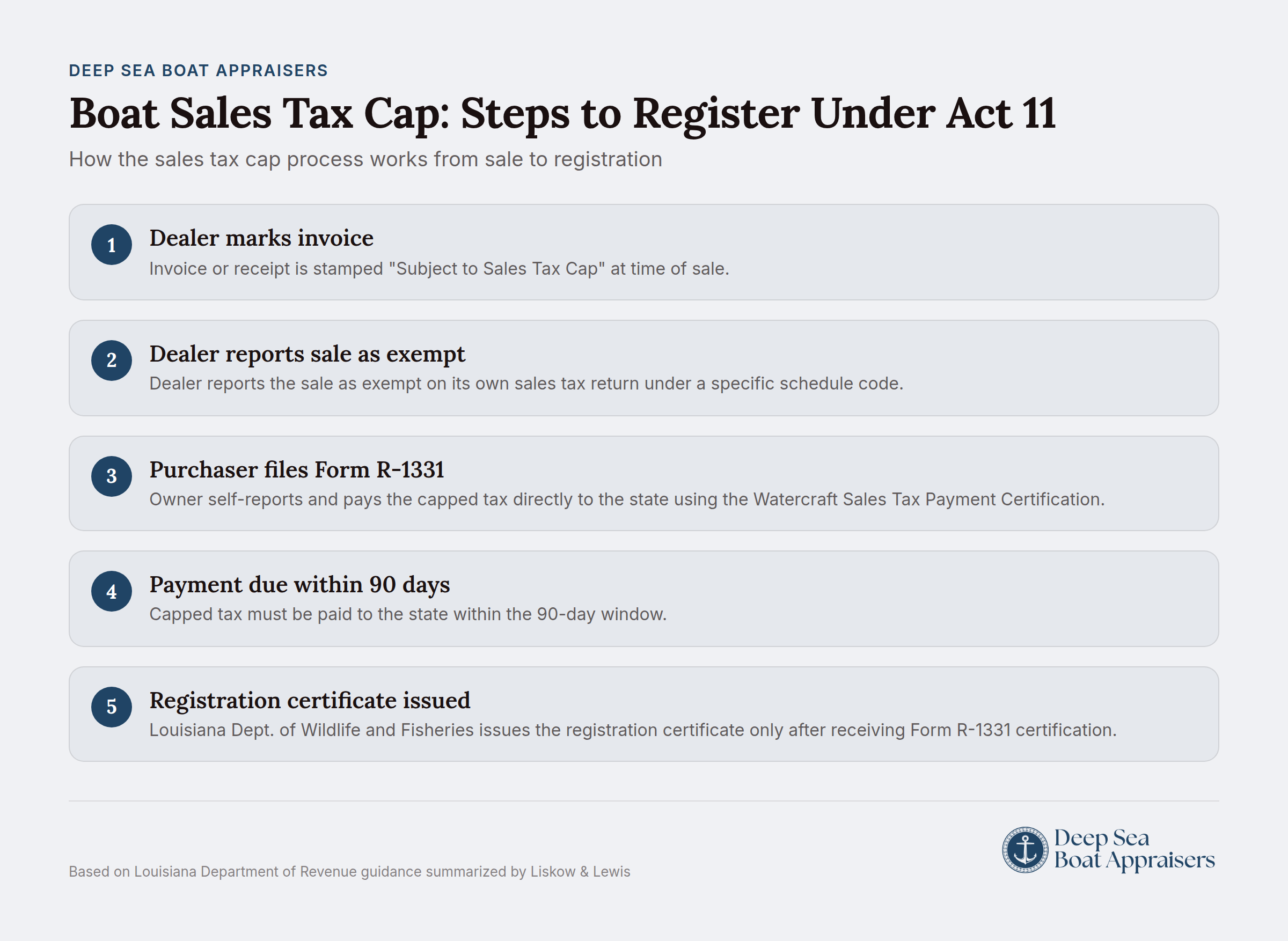
Proof that the sales or use tax has been paid, and paid on time, is a prerequisite for registration, not an afterthought. Owners self-report and pay the capped tax using Form R-1331, the Watercraft Sales Tax Payment Certification, and the Louisiana Department of Wildlife and Fisheries will not issue a registration certificate without that certification in hand.
When the cap applies to a sale, dealer procedure follows a specific pattern under Department of Revenue guidance summarized by Liskow & Lewis:
- The dealer marks the invoice or receipt "Subject to Sales Tax Cap."
- The dealer reports the sale as exempt on its own sales tax return under a specific schedule code, rather than collecting tax beyond the cap at the point of sale.
- The purchaser is responsible for self-reporting and paying the capped tax directly to the state, using Form R-1331, within the 90-day window.
Pro tip: Keep a copy of the dealer invoice showing the "Subject to Sales Tax Cap" notation alongside your filed Form R-1331. If the Department of Revenue ever questions the transaction, that paper trail shows the cap was properly invoked rather than tax simply being missed.
Boats Brought Into Louisiana From Out of State: Original Cost vs. Fair Market Value
For a boat purchased outside Louisiana and later brought into the state, use tax is generally computed on whichever is lower: the boat's original purchase price or its fair market value at the time it entered Louisiana. That distinction matters most for boats that have depreciated between the purchase date and the date they cross into Louisiana waters, whether that gap is a few months or several years.
This is where a documented, USPAP-compliant fair market value appraisal becomes directly relevant to the tax calculation. If a boat has lost value since its original purchase, an independent appraisal can support using the lower, current fair market value as the tax basis rather than the original invoice price. The appraisal does not reduce or guarantee any particular tax outcome; the Department of Revenue still applies the statute and makes its own determination. What the appraisal provides is a documented, professionally supported value that the owner can point to if the declared value is ever questioned.
Key takeaway: An appraisal is documentation that supports the value used in the tax calculation. It is not a discount, and it does not override the Department of Revenue's authority to review a return.
Credit for Tax Already Paid to Another State
If you already paid sales or use tax to another state on the same boat, Louisiana applies a credit for that amount before determining whether the $20,000 cap comes into play. In practice, this means the cap is evaluated against your remaining Louisiana liability after the out-of-state credit, not against the full pre-credit tax amount. Owners who purchased a boat elsewhere and are now registering it in Louisiana should have documentation of the tax already paid ready when they file Form R-1331, since that credit affects the final number due.
The cap itself is not permanent at $20,000. Starting July 1, 2030, the amount is scheduled to adjust for inflation every five years, with the Department of Revenue publishing updated figures. The underlying regulation implementing the statute, adopted in 2026, is covered in reporting from Bloomberg Tax.
Getting the Documentation Right Before You Register
Owners registering a boat in Louisiana after July 1, 2025, especially one purchased or previously registered out of state, should treat the tax filing and the value documentation as one task rather than two separate steps. Confirm the registration and payment dates line up with the 90-day requirement, gather proof of any tax already paid elsewhere, and if the boat has depreciated since purchase, have a fair market value appraisal prepared before you file Form R-1331. Our team prepares USPAP-compliant boat appraisals built for exactly this kind of documentation need; you can request an appraisal before your registration deadline arrives.
This article is provided for general informational purposes only and does not constitute legal, tax, or financial advice. Readers should consult a qualified attorney or CPA regarding their specific circumstances.