
Blog
How to Win a Louisiana Commercial Boat Property Tax Appeal on an Inflated Assessment
A Louisiana commercial boat property tax appeal follows a strict sequence: parish Board of Review, then the Louisiana Tax Commission, then district court, each with its own deadline. This guide walks owners of tugboats, OSVs, crew boats, and charter vessels through the filing requirements, the appeal path, and the evidence that actually moves an inflated assessment.
If you own a documented commercial vessel operating out of a south Louisiana parish, your boat is almost certainly on the assessor's rolls as business personal property, not real estate. Every year, parish assessors apply a cost-based formula to vessels like tugboats, crew boats, OSVs, trawlers, and charter boats, and that formula does not always reflect what a specific vessel is actually worth. When the resulting tax bill feels too high, Louisiana law gives commercial vessel owners a defined path to contest it, but that path has firm deadlines and specific forms at every stage.
This guide covers how parishes value commercial vessels, what you are required to file each year, and the three-step appeal sequence that runs from the parish Board of Review through the Louisiana Tax Commission (LTC) and, if necessary, into district court. For background on how a USPAP-compliant marine appraisal is actually built, see our commercial vessel appraisal guide for Louisiana owners.
Why Your Assessment Might Be Inflated
Parish assessors value most commercial watercraft using mass appraisal: a cost schedule that starts from a reported original acquisition cost, trends it forward, and applies a standard depreciation table for age. That approach works reasonably well across a large population of generic assets, but it was never built to capture what makes one 1998 crew boat worth meaningfully more or less than another.
A cost schedule cannot see a lapsed U.S. Coast Guard inspection certificate, an engine overhaul, months of lay-up time, a restricted trade route, or hull damage from a recent storm. It also cannot see the opposite: a well-maintained vessel with a clean survey history and a strong charter record that might be worth more than the schedule assumes. That gap between a generic cost-schedule number and a vessel-specific fair market value is exactly where most successful appeals are won.
How Louisiana Calculates Your Assessed Value
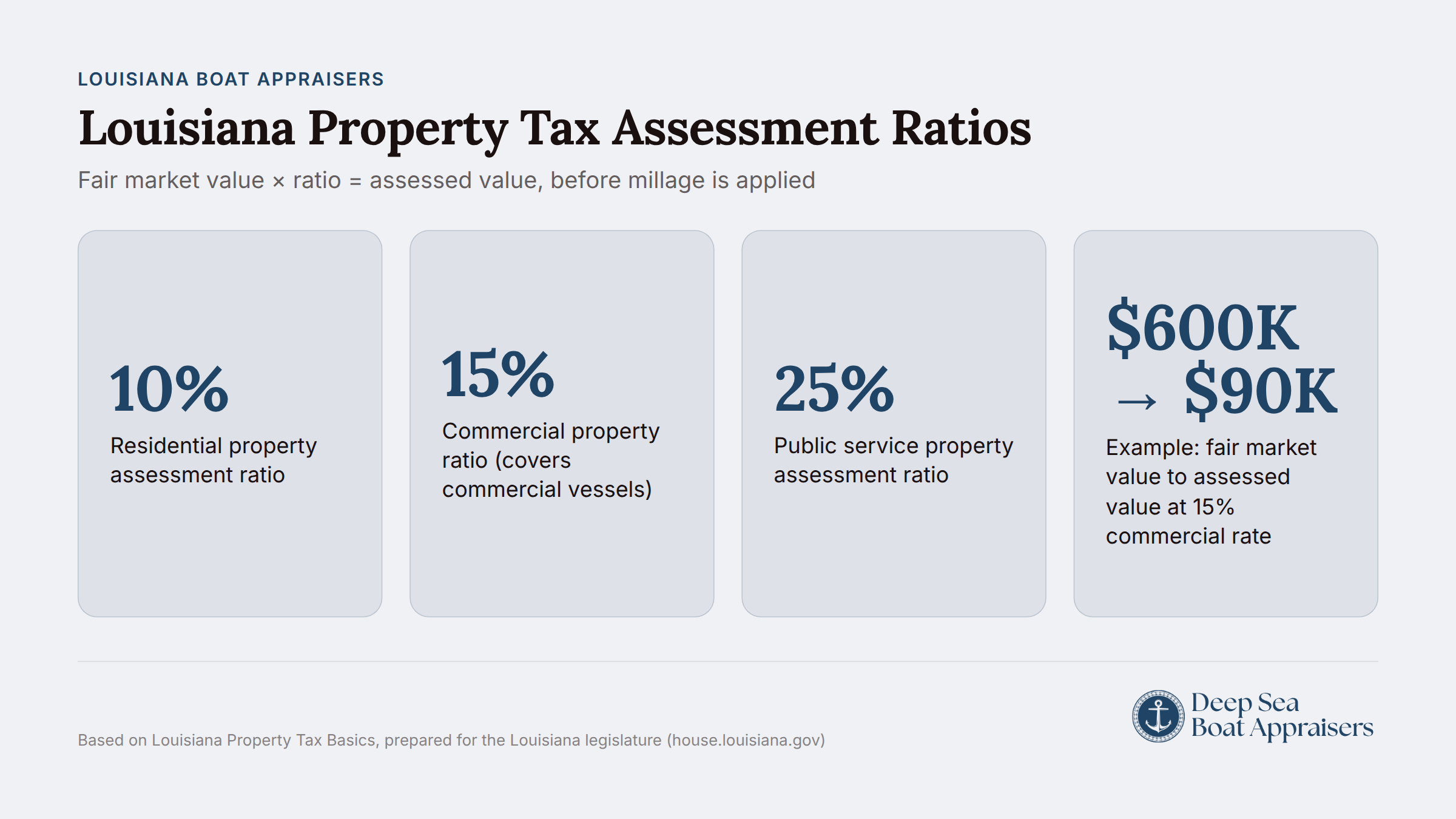
Louisiana's constitution sets different assessment ratios depending on the type of property. Residential property is assessed at 10% of fair market value, commercial property (the category that covers a commercial vessel treated as business personal property) is assessed at 15%, and public service property is assessed at 25%, as outlined in the Louisiana Property Tax Basics summary prepared for the legislature. Your tax bill is calculated by multiplying the assessed value (fair market value times the applicable ratio) by the local millage rate.
Example: If a parish assessor determines your crew boat has a fair market value of $600,000, the assessed value at the 15% commercial ratio is $90,000. If an independent appraisal supports a fair market value of $420,000 instead, the assessed value drops to $63,000, a meaningful swing before millage is even applied.
Key takeaway: Almost every commercial vessel tax dispute is really a fair market value dispute, not a dispute over the 15% ratio itself. The ratio is fixed by law; the fair market value is the number worth contesting.
Filing Your Annual Watercraft Report
Most parishes require commercial vessel owners to file an annual watercraft property report, commonly identified as Form LAT 11A, disclosing ownership, situs, acquisition cost, vessel description, and other valuation data. This report is generally due by April 1 or within 45 days of receiving the form from the assessor, whichever date falls later.
Filing this report accurately and on time matters for more than avoiding a penalty. In many parishes, failing to file, or filing incomplete or inaccurate information, can weaken or jeopardize your later ability to contest the resulting assessment. Treat the annual report as the first step in protecting your right to appeal, not as a formality to rush through.
Watch out: If your vessel changed hands, was relocated, or underwent major repairs during the year, make sure the report reflects that. An assessor working from stale or incomplete data has little reason to deviate from the standard cost schedule.
The Three-Step Appeal Path
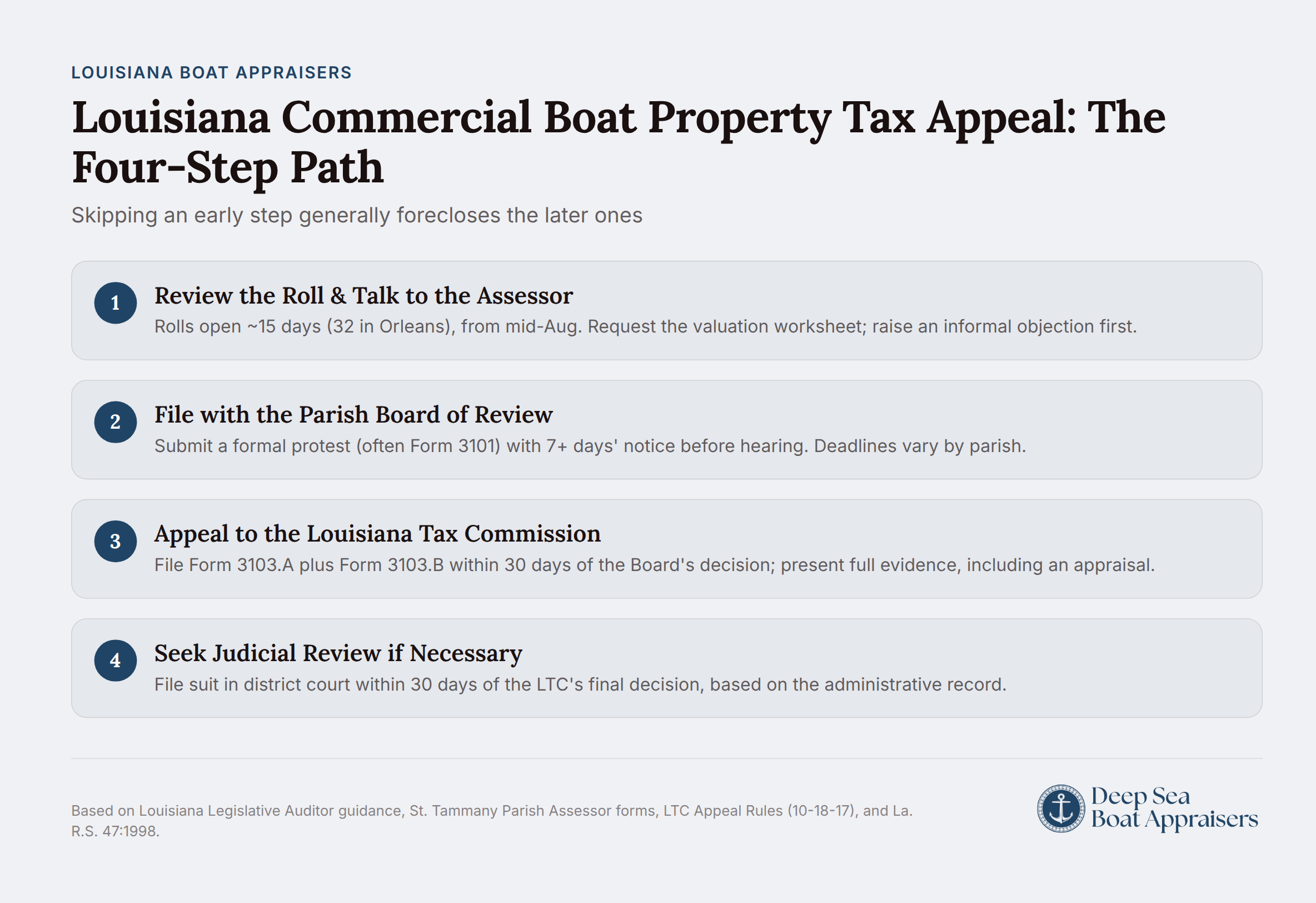
A Louisiana commercial boat property tax appeal moves through three distinct stages, and skipping the first one generally forecloses the others. The Louisiana Tax Commission does not typically hear an appeal that bypassed the parish Board of Review.
- Review the Roll and Talk to the Assessor
- Parish assessment rolls are open for public inspection each year, generally for a 15-day window beginning no earlier than August 15 and ending no later than September 15 (Orleans Parish runs a longer, 32-day window), according to guidance published by the Louisiana Legislative Auditor.
- Use this window to request the assessor's valuation worksheet for your vessel and raise an informal objection before filing a formal protest. Many disputes resolve here without a hearing.
- File a Protest with the Parish Board of Review
- If the informal conversation does not resolve the issue, file a formal notice of appeal with the parish Board of Review, commonly on a form identified locally as Form 3101, as described in parish assessor filing guidance such as the St. Tammany Parish Assessor's forms page.
- You generally must give the Board at least 7 days' notice before your hearing. Deadlines to file vary parish to parish, so confirm the posted date with your local assessor's office immediately after the roll opens.
- Appeal to the Louisiana Tax Commission
- If the Board of Review's written decision still does not reflect your vessel's fair market value, you can appeal to the LTC using Form 3103.A, with supporting documentation submitted on Form 3103.B, within 30 days of receiving the Board's decision, per the appeal procedures published in the Louisiana Tax Commission appeal rules.
- The LTC's review is your opportunity to present a full evidentiary record, including an independent appraisal, rather than simply repeating that the number feels too high.
- Seek Judicial Review if Necessary
- A party still dissatisfied after the LTC's final decision may file suit in district court within 30 days of that decision, as set out in Louisiana Revised Statutes 47:1998.
- Judicial review is based on the administrative record built during the Board of Review and LTC stages, which is one more reason to build a strong, documented case from the start rather than treating the early steps as a formality.
What Evidence Actually Moves the Needle
A successful appeal almost always comes down to whether your documentation outweighs the assessor's mass-appraisal cost schedule. Boards of Review and the LTC are directed to evaluate an assessment's validity using recognized appraisal techniques, which means they are set up to weigh real evidence, not just a disagreement about the total.
Evidence that typically carries weight in a commercial vessel appeal includes:
- Purchase and acquisition records: invoices, bills of sale, and financing documents showing what the vessel actually cost and when.
- An independent fair market value appraisal: a report addressing the vessel's condition, utilization, and market position as of the relevant assessment date, not a generic retail guide figure.
- Comparable sales data: recent transactions involving similar documented commercial vessels of comparable type, age, size, and service history.
- Utilization and charter or income records: logs, contracts, and revenue data showing how the vessel is actually being used.
- Repair, survey, and inspection history: marine survey reports and maintenance records documenting condition and any deferred work.
- Evidence of obsolescence: documentation of a lapsed or restricted U.S. Coast Guard inspection certificate, extended lay-up periods, or a limited trade route, each of which can depress a vessel's fair market value in ways a cost schedule will not reflect.
Pro tip: File your appraisal and supporting records with your Board of Review protest, not just at the LTC stage. A well-documented record early in the process often shortens the entire appeal and can resolve the dispute before it ever reaches the Tax Commission.
How Fair Market Value Is Actually Determined
Louisiana's own administrative guidance recognizes that watercraft can be valued using the cost, market, or income approach, and that watercraft not employed in interstate commerce are subject to parish assessment, per the valuation standards set out in Louisiana Administrative Code Title 61, Section V-701. Whether a vessel's documented status affects its classification or situs is a fact-specific question, and a thorough appeal should address it directly rather than assume documentation alone changes the outcome.
This is also where the difference between a generic valuation and a professional appraisal matters most. An appraisal prepared in accordance with USPAP (the Uniform Standards of Professional Appraisal Practice maintained by The Appraisal Foundation) addresses fair market value as of a specific date, supported by comparable sales, cost analysis, and documented condition, rather than a desk-top estimate pulled from a generic pricing guide. For guidance on how that process works for a Louisiana vessel, see our overview of how to get your boat appraised.
Because commercial vessel appraisal fees are quoted as a fixed fee after scoping the assignment (never tied to the vessel's value and never billed hourly), owners can budget for an appraisal before committing to the appeal process. The scope, including vessel type, documentation available, and the depth of analysis required for a tax appeal, determines the fee, not the dollar amount at stake in the dispute.
Building a Record That Holds Up
An inflated commercial vessel assessment rarely gets corrected by simply calling the assessor's office and asking for a lower number. It gets corrected by building a record, starting with an accurate annual report, continuing through an informal review and a timely Board of Review protest, and backed by a vessel-specific appraisal that speaks the same evidentiary language the Board and the Louisiana Tax Commission are set up to evaluate.
If you believe your tugboat, OSV, crew boat, or charter vessel is assessed above its actual fair market value, the clock on your appeal rights starts the moment the roll opens for inspection. Request an appraisal from our team to get a USPAP-compliant fair market value report built for the assessment date, before your parish's filing deadline passes.
This article is provided for general informational purposes only and does not constitute legal, tax, or financial advice. Readers should consult a qualified attorney or CPA regarding their specific circumstances.