
Blog
Louisiana Community Property and Boats: How Divorce Courts Value and Split a Vessel
In a Louisiana community property divorce, a boat bought during the marriage is presumed marital property no matter whose name is on the title, and state law values it as of trial, not the day you filed. This guide explains how classification, timing, and a neutral fair market value appraisal determine what each spouse actually walks away with.
Louisiana is one of only a handful of true community property states, and that single fact changes almost everything about how a boat gets handled in a divorce. If you and your spouse bought a boat while married, state law generally treats it as jointly owned property to be divided, regardless of whose name is on the registration. This guide walks through how a boat gets classified, when the court actually puts a dollar figure on it, and why an informal dealer quote or a lowball buyer offer won't resolve a real dispute over what the vessel is worth.
When the two sides can't agree on a number, a neutral fair market value appraisal gives the court something defensible to work with instead of two competing guesses. We prepare those reports for Louisiana boat owners going through exactly this situation, and you can request a Louisiana boat appraisal once you know what the process requires.
Is a Boat Bought During Marriage Community Property in Louisiana?
Yes, in almost every case. Louisiana's community property system treats property acquired during the marriage through either spouse's effort, skill, or with community funds as owned equally by both spouses, each holding an undivided one-half interest. A boat purchased while married falls under that presumption the same way a car, a house, or a retirement account does.
Whose name appears on the title, the registration, or the U.S. Coast Guard documentation does not decide ownership by itself. Louisiana law presumes that movable property acquired or possessed during the marriage belongs to the community, and the spouse who wants to claim otherwise carries the burden of proving it, under the classification principles set out in Louisiana's Civil Code provisions on matrimonial regimes.
A boat can still be separate property under a narrower set of circumstances:
- Owned before the marriage: A vessel purchased before the wedding date generally stays that spouse's separate property.
- Inheritance or gift: A boat received as a donation or inheritance from someone other than the spouse stays separate, even if it was received during the marriage.
- Traceable separate funds: If a spouse can document that the purchase price came entirely from separate money, such as an inheritance kept in its own account, the boat can be classified as separate.
- Formal reservation: A spouse can transfer separate property into the marriage, but Louisiana law requires that transfer to happen through a written act, and a gratuitous transfer generally needs a formal notarized act to count.
Watch out: The burden of proof runs against the spouse claiming separate ownership, not in their favor. Bank statements, purchase agreements, and gift letters matter far more than a title showing only one name.
When Does Louisiana Law Actually Value the Boat?
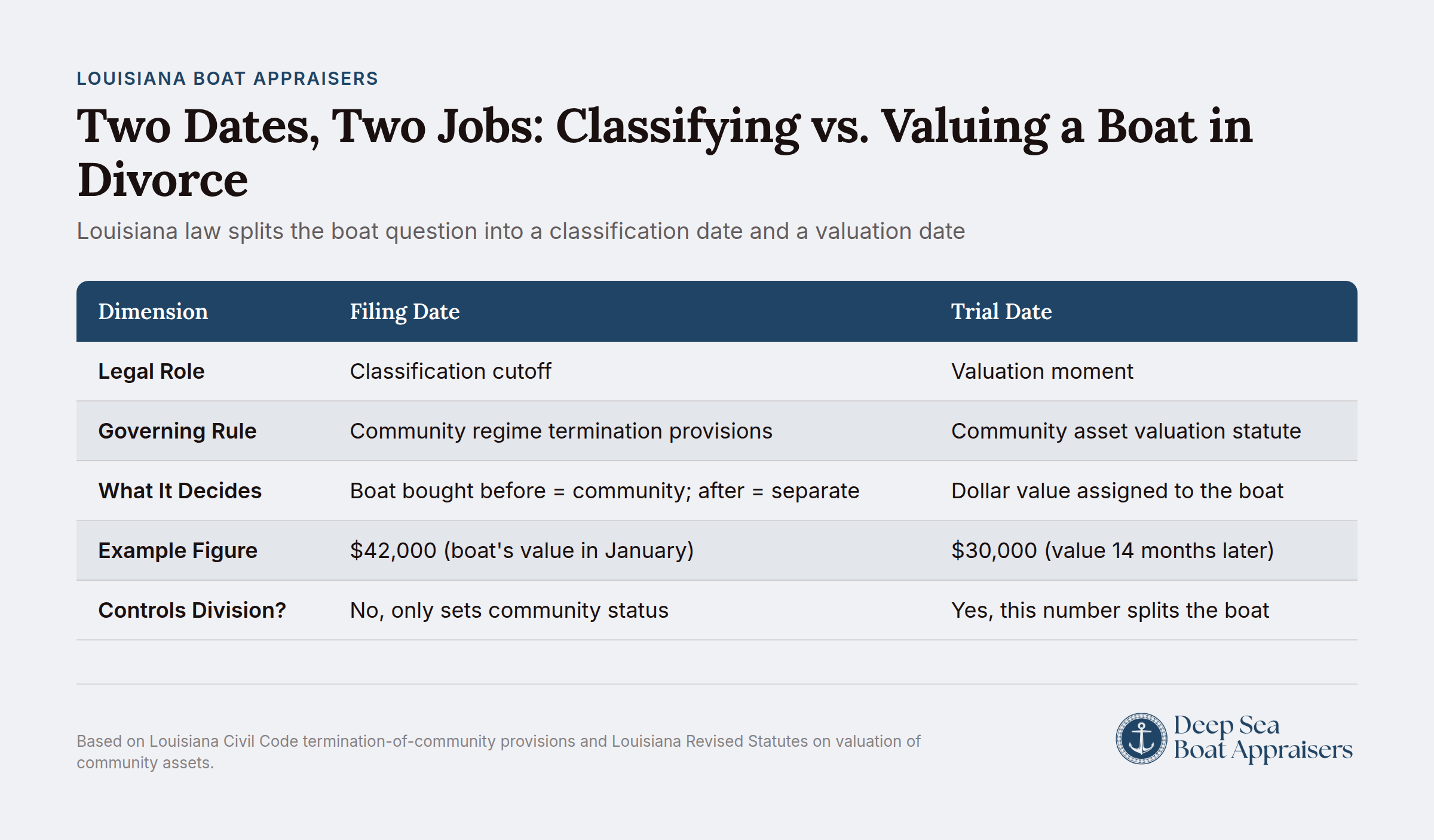
The court values the boat as of the trial on the merits, not the date either spouse filed for divorce and not the date they separated. This is a meaningful distinction, because a boat's market value can move a lot between filing and trial, sometimes by tens of thousands of dollars depending on the vessel, the market, or storm damage.
There are actually two different dates doing two different jobs. The community regime terminates retroactively to the date the divorce petition was filed, and that filing date decides which side of the classification line a purchase falls on: a boat bought before filing is community, one bought after is typically separate, per the termination provisions of Louisiana's community property law. But once a boat is classified as community property, the dollar value assigned to it is measured at trial, under Louisiana Revised Statutes governing the valuation of community assets.
Example: A couple files for divorce in January, when their boat's fair market value sits around $42,000. Trial doesn't happen for another 14 months, and by then the same boat, after a hurricane season and some deferred maintenance, is worth closer to $30,000. The $30,000 figure controls the division, not the number from the day the petition was filed.
Why a Dealer Trade-In Quote and a Buyer's Lowball Offer Can't Settle the Dispute
A dealer trade-in quote and a private buyer's opening offer are not neutral numbers, and courts know it. A dealer needs margin to resell the boat, so a trade-in figure is built to be low. A buyer's first offer is a negotiating tactic, not an appraisal, and it's built to be low too. Splitting the difference between two biased numbers just produces a third biased number.
Louisiana's partition process requires each spouse to file a detailed descriptive list of community assets along with a fair market value for each one, a standard grounded in public guidance from the Louisiana State Bar Association on how community property is valued at settlement. Fair market value means what a willing buyer would pay a willing seller in an arm's-length sale, not what a dealer wants to pay or what a stranger is hoping to lowball you into accepting.
That's why attorneys and courts turn to a qualified marine appraiser rather than either party's informal estimate. Our appraisers hold credentials with organizations such as the Certified Appraisers Guild of America (CAGA), the National Association of Marine Surveyors (NAMS), and the American Society of Appraisers (ASA), and every report we deliver is prepared in accordance with USPAP, the Uniform Standards of Professional Appraisal Practice. Understanding how boat value gets determined before the dispute reaches a courtroom saves both spouses time and legal fees later.
Our boat appraisal fees are quoted as a fixed fee scoped to the vessel and the intended use of the report, never billed hourly. A litigation-ready fair market value report for most recreational boats typically starts around $295 for an advanced report, with fees generally running between $195 and $495 for standard cases, and higher for larger or more complex vessels.
What a Fair Market Value Boat Appraisal Actually Documents
A proper fair market value appraisal doesn't just produce a number. It builds a record that can hold up if either spouse challenges the valuation later. A complete report for a marital boat typically documents:
- Identification: Make, model, year, and hull identification number (HIN), confirmed against registration and documentation.
- Engine and hours: Total engine hours, service history, and any major repairs or replacements.
- Condition: A detailed inspection covering the hull, mechanical systems, electronics, and cosmetic condition.
- Maintenance records: Documentation of upkeep, storage conditions, and any damage history, including storm or flood exposure.
- Comparable sales: An analysis of recently sold comparable vessels, not asking prices on listing sites, which tend to run high.
Pro tip: Gather maintenance receipts, survey reports, and photos before the appraiser's inspection. A well-documented history supports a stronger, more defensible valuation, especially for boats with upgrades that a quick market scan won't reflect. Learning how the boat appraisal process actually works ahead of time helps both spouses know what to expect.
Using the Boat While the Divorce Is Pending
Either spouse can petition the court for temporary use of community property, including a boat, while the divorce is pending and before the assets are formally divided. Louisiana law gives courts authority to allocate use of community movable property pending partition, weighing each spouse's economic circumstances, the needs of any children, and the overall best interest of the family.
This doesn't resolve ownership. It just decides who gets to use the boat, or store it, or maintain it, until the partition happens. Whoever has control of the boat during this period has a duty to preserve it and manage it prudently; they can't sell it, mortgage it, or let it deteriorate out of spite.
How the Boat Fits into the Broader Partition Process
Once a boat is classified as community property, it becomes one line item in a much larger accounting. Louisiana's judicial partition process follows a defined sequence when spouses can't agree on their own:
- File a detailed descriptive list. Each spouse lists every community asset and liability, including the boat, with a stated fair market value.
- Respond or traverse. The other spouse has a window to concur with the list or formally challenge specific classifications or values, including the boat's stated worth.
- Court determines classification and value. At trial, the judge decides what's community, what's separate, and what each disputed asset, including the boat, is actually worth.
- Divide the net value equally. The court aims for a 50/50 split of net community value. If one spouse keeps the boat, that value gets weighed against everything else in the estate.
- Order equalizing payments if needed. When one spouse ends up with more value in physical assets, the court can order a cash payment, secured by a note or lien, to even things out, or order the boat sold and the proceeds split.
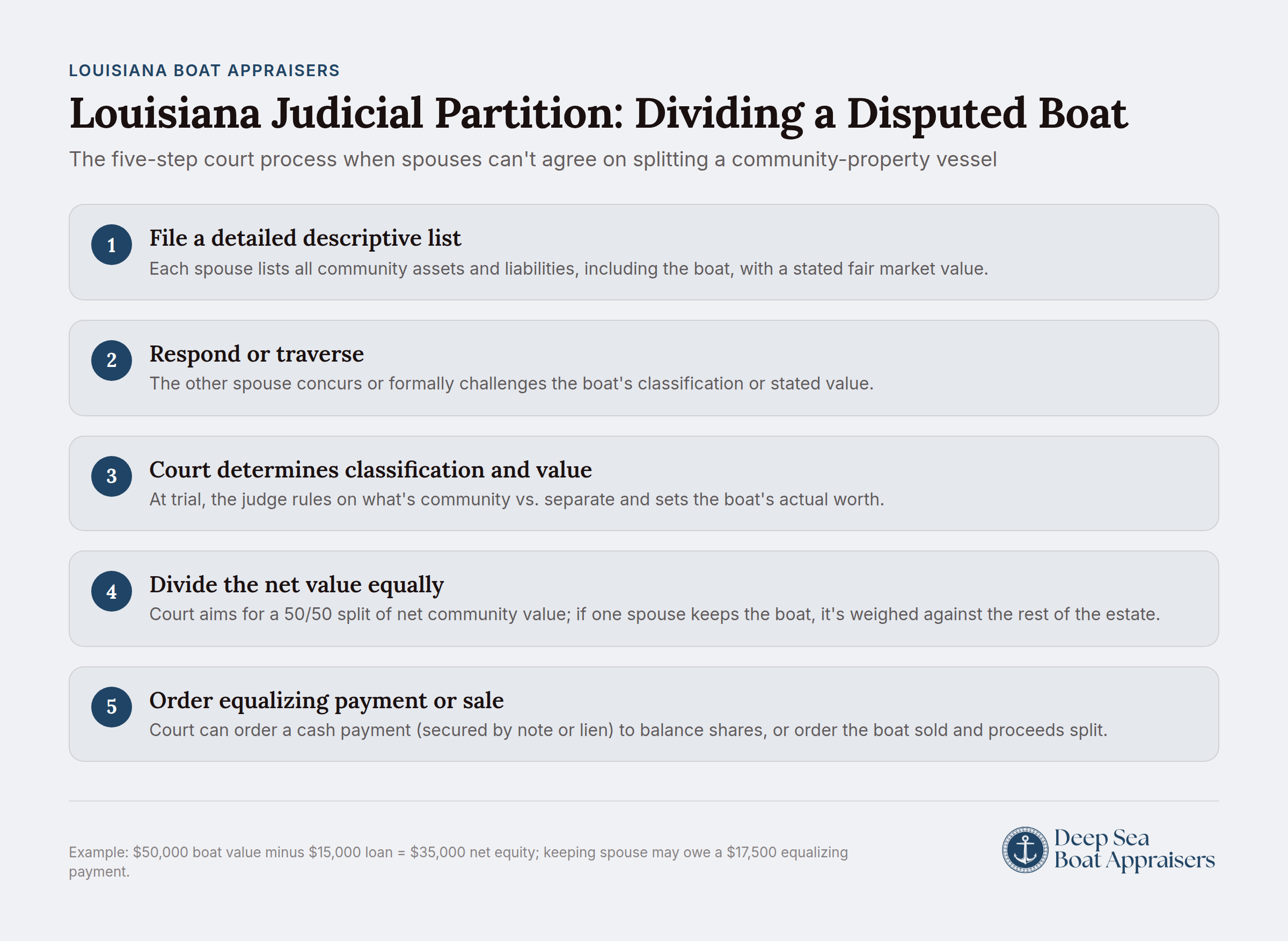
Example: Suppose the boat's fair market value comes in at $50,000 with a $15,000 loan balance still owed, for $35,000 in net equity. If one spouse keeps the boat, that $35,000 counts against their share of the estate, and the other spouse may be owed an equalizing payment of $17,500 in cash or other assets to balance it out. Alternatively, the court can simply order the boat sold and the net proceeds split evenly.
One more wrinkle worth flagging: if a spouse uses separate funds to keep making payments on a boat loan after the community terminates, Louisiana law provides a reimbursement mechanism for registered community movables paid with separate funds, adjusted for that spouse's continued use of the boat during that period. This can shift the net numbers in the final accounting, so it's worth raising with your attorney if it applies to your situation.
Getting a Defensible Number Before the Numbers Get Disputed
A boat is rarely the biggest asset in a Louisiana divorce, but it's often the one spouses fight over hardest, because the numbers floating around (a dealer's trade-in offer, a friend's guess, an old insurance appraisal) rarely agree with each other. Settling on a single, neutral, fair-market-value figure early tends to save both time and legal fees later, whether the case settles or goes to trial.
Key takeaway: The valuation date is trial on the merits, the classification presumption favors community property, and a USPAP-compliant fair market value report from a qualified marine appraiser is the tool courts and attorneys actually rely on to resolve a disputed boat value, not an informal quote from either side.
If you and your spouse are heading toward a partition and need a fair market value figure for a boat, our team can scope the assignment and quote a fixed fee before any work begins.
This article is provided for general informational purposes only and does not constitute legal, tax, or financial advice. Readers should consult a qualified Louisiana family law attorney regarding their specific circumstances.