
Blog
How Louisiana Succession Law Treats Boats and Other Movable Property
Louisiana's civil law succession system handles boats differently than probate in other states, and getting the value wrong on the sworn descriptive list can slow down a family's inheritance. Here's how succession representatives identify, list, and value a boat for a Louisiana estate.
When a Louisiana resident dies owning a boat, that vessel becomes part of a legal process most Americans have never heard of: succession. Louisiana is the only state built on a civil law tradition rather than English common law, and the vocabulary, deadlines, and duties around estate settlement reflect that. If you're an heir, executor, or administrator trying to figure out what a decedent's boat is worth and how it moves into your name, understanding succession law first will save you time, money, and confusion.
This guide walks through how Louisiana succession law classifies a boat, when a simplified affidavit process applies, and why the person handling the estate has a legal duty to value the boat accurately. If a boat is part of the picture, getting it professionally appraised is often the difference between a smooth transfer and a dispute among heirs.
Succession vs Probate: Louisiana's Civil Law Framework
Louisiana does not use the word "probate." It uses "succession," and the difference is more than terminology. Most of the country inherited its property law from English common law, while Louisiana's civil code descends from French and Spanish civil law traditions, often called the Napoleonic Code framework, as explained by the LSU Center of Civil Law Studies. That heritage shapes how Louisiana defines property, how it distinguishes movables from immovables, and how it organizes the entire estate settlement process.
In a common law state, a personal representative or executor manages probate through a court-supervised process that varies widely by state. In Louisiana, the person who settles the estate is called a succession representative: an executor if the decedent left a will (called a testament), or an administrator if the decedent died intestate. The underlying duties are similar to probate elsewhere, but the legal terms, the code articles, and several of the procedural shortcuts are distinctly Louisiana.
What Is a Small Succession Affidavit?
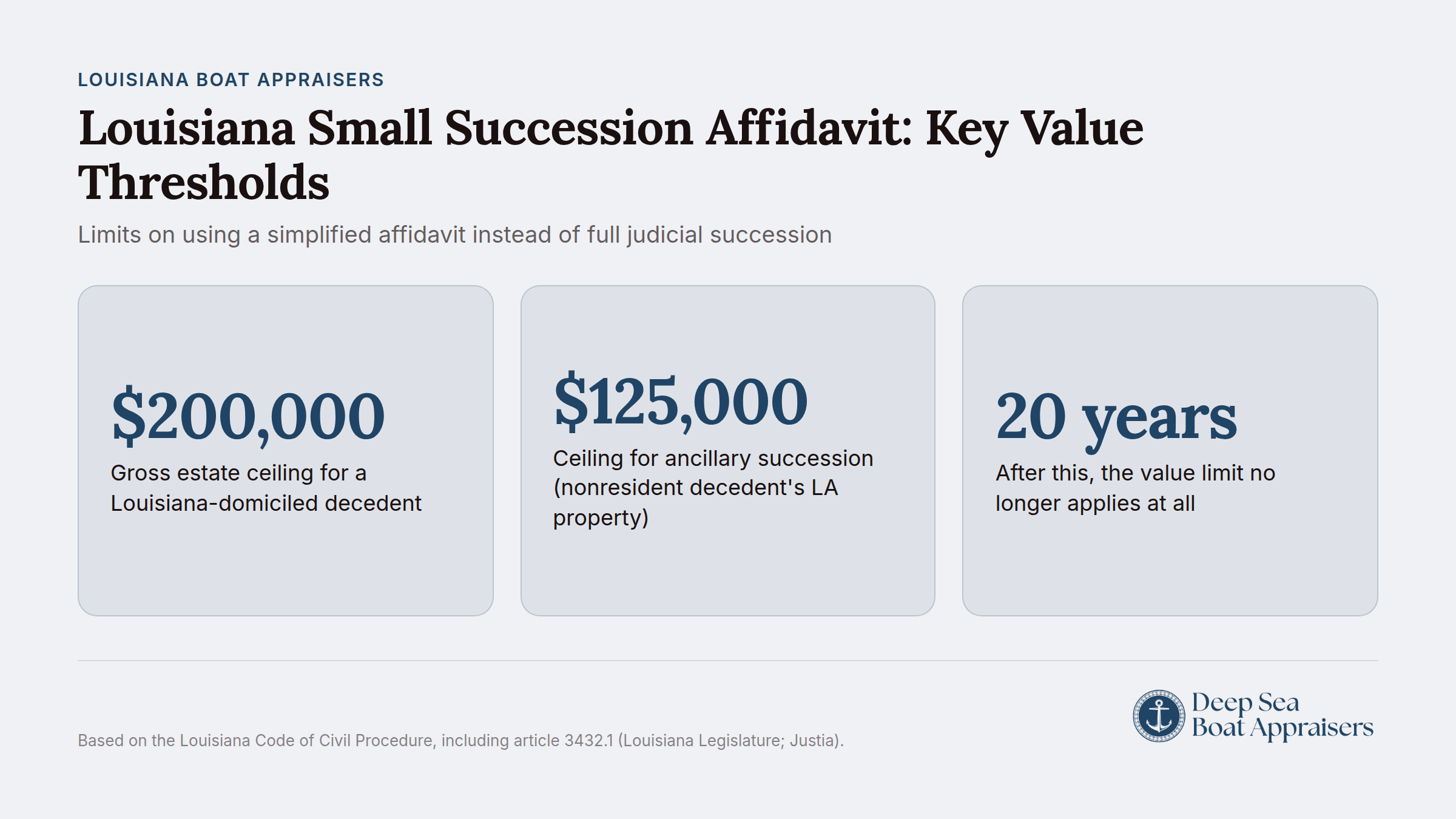
A small succession affidavit lets an heir transfer a decedent's property without opening a full judicial succession, as long as the estate's gross value falls under a statutory ceiling. For a Louisiana-domiciled decedent, that ceiling is generally $200,000 in gross estate value measured as of the date of death. For an ancillary succession, meaning a nonresident decedent who left Louisiana property behind, the limit drops to $125,000.
These thresholds matter because a boat is often one of the larger single assets in a modest estate, and its value can push a family right up against the line. The Louisiana Code of Civil Procedure governs when the affidavit process is available, and the value limit does not apply at all once 20 years have passed since the death, a provision meant to clear old, unresolved estates (Louisiana Legislature).
A key procedural detail: the affidavit process for transferring movable property applies only when there is no immovable property (real estate) involved in the Louisiana succession, as set out in the code provision covering movable-only affidavits (Louisiana Code of Civil Procedure, article 3432.1). If the estate includes a house or land, the family typically needs a different procedural path, even if a boat is the only other asset of significance.
The Succession Representative's Duty to Value Movable Property
Whether an estate goes through a judicial succession or qualifies for the small succession affidavit, someone has to identify and value everything the decedent owned. That job falls to the succession representative, and it is not optional or informal. Louisiana law requires a sworn descriptive list or a formal inventory that captures each item of property, movable and immovable, at its fair market value as of the date of death, not at some later date and not net of debts.
That duty applies just as much to a boat as it does to a bank account or a piece of furniture. Louisiana successions guidance describes the representative's obligation to identify the type and amount of property in the estate as a foundational step before any distribution or affidavit can move forward (Loyola University succession resources). If the estate representative simply guesses at the boat's value, or relies on what the decedent originally paid years earlier, the sworn descriptive list becomes vulnerable to challenge by an heir, a creditor, or the court itself. Knowing how a boat's value is determined in the first place, through comparable sales, condition, and market data, keeps that list defensible.
Watch out: Listing a boat at its purchase price or its insured value instead of its current fair market value is one of the most common mistakes families make when preparing a sworn descriptive list. Boats depreciate, and market conditions shift, so the number needs to reflect the date of death, not the date of purchase.
Boats as Movable Property Under Louisiana Law
A boat is legally classified as movable property in Louisiana, distinct from immovables like land, buildings, and things permanently attached to land. That classification is what allows a boat to be transferred through the small succession affidavit process (when the estate otherwise qualifies) rather than requiring the fuller judicial succession that immovable property often triggers.
Because a boat registered in the decedent's name still needs a formal title transfer, the Louisiana Department of Wildlife and Fisheries publishes a dedicated affidavit for exactly this situation. The Affidavit for Transfer of Decedent's Boat lets heirs or legatees confirm ownership and consent to the transfer so the vessel's title can move out of the decedent's name (Louisiana Department of Wildlife and Fisheries).
One wrinkle families often ask about: whether the boat was community property (acquired during a marriage) or separate property (owned before the marriage or received as a gift or inheritance) changes who is entitled to inherit it and in what share. It does not change the succession representative's duty to value the boat accurately. Every movable in the estate gets listed at fair market value regardless of which spouse or heir eventually receives it. The classification question is about ownership rights; the valuation question is about the number that goes on the sworn descriptive list.
Why a Professional Appraisal Strengthens the Sworn Descriptive List
A professional appraisal gives the succession representative a defensible, documented fair market value for the boat, which matters most when the vessel represents a meaningful share of the estate or when heirs disagree about what it's worth. Courts, creditors, and co-heirs are far less likely to challenge a valuation that comes from a qualified appraiser than one the family estimated informally.
This becomes especially important in a few common scenarios:
- The boat pushes the estate near the small succession threshold. An inflated or deflated informal estimate could wrongly qualify or disqualify the estate from using the simplified affidavit process.
- Heirs disagree on value. A family that can't agree on what a boat is worth often can't agree on how to divide the estate, and a third-party appraisal removes the guesswork.
- The boat is being sold as part of the succession. Louisiana law ties certain succession property sales to the appraised value shown in the inventory or descriptive list, so an outdated or informal number can create problems if the vessel needs to be sold to settle debts or divide proceeds.
- The estate will face scrutiny from creditors or the court. A written, standards-based appraisal report holds up better under review than a family member's best guess.
A qualified marine appraisal documents the boat's condition, equipment, hours, maintenance history, and comparable market sales as of the date of death, giving the succession representative a number that can stand behind the sworn descriptive list. Families navigating a Louisiana succession for the first time are usually dealing with grief, deadlines, and unfamiliar legal terms all at once. Getting a clear, professional valuation for the boat is one part of the process that doesn't have to be complicated.
If you're settling a Louisiana estate that includes a boat, our appraisers can help you request an appraisal that documents fair market value as of the date of death, giving you a number the succession representative, the heirs, and the court can all rely on.
This article is provided for general informational purposes only and does not constitute legal, tax, or financial advice. Readers should consult a qualified Louisiana succession attorney regarding their specific circumstances.