
Blog
When Does a Louisiana Boat Loan Require an SBA-Compliant Appraisal?
Louisiana shrimpers and charter operators financing a vessel through an SBA 7(a) or bank loan need to know when the lender will require an independent marine appraisal rather than a desktop review. This guide walks through the dollar thresholds, value definitions, and inspection standards that determine when an appraisal becomes mandatory.
Louisiana's commercial fishing and charter boat operators rely on financing to buy, upgrade, or refinance the vessels that keep their businesses running. When that financing comes through an SBA 7(a) loan or a bank's commercial lending program, the lender's appraisal requirements often determine how smoothly the deal closes. This guide explains when a lender will require an independent vessel appraisal, what value definition applies, and what the process looks like for a working boat rather than a weekend cruiser. Our commercial vessel appraisal service covers shrimp boats, workboats, and charter vessels across the state, and this article breaks down the lending rules that make an appraisal necessary in the first place.
Louisiana's Commercial Fishing and Charter Fleet Runs on Financing
Louisiana's commercial fishing industry supports thousands of jobs and hundreds of millions of dollars in annual landings value, anchoring coastal economies from Delcambre to Venice. The state's charter fishing sector adds tens of millions more in economic activity each year, drawing anglers to redfish flats, offshore rigs, and inland estuaries. Precise vessel-level ownership and financing figures are not publicly published, largely because lenders and borrowers treat individual loan details as confidential business information.
What is not confidential is how these boats get financed. Shrimpers replacing an aging steel hull, charter captains adding a second boat, and oyster operations refinancing existing debt all typically turn to SBA-backed loans or direct bank financing secured by the vessel itself. That security interest is exactly what triggers the appraisal question.
Why Lenders Require an Independent Appraisal, Not a Desktop Review
A lender requires an independent, USPAP-compliant appraisal whenever the credit decision relies on the vessel's fixed-asset value, particularly when that value exceeds the boat's net book value on the borrower's balance sheet. Public guidance on SBA lending practices makes clear that lenders cannot simply accept a borrower's own estimate or a quick online valuation when real collateral value is doing the work of securing the loan, as outlined in SBA-focused appraisal practice guidance.
A desktop valuation, one built from photos, a hull identification number, and a market database, works fine for a personal insurance claim or an estate inventory. It rarely satisfies a lender financing a commercial vessel. Shrimp boats, charter boats, and other income-producing craft carry engine hours, gear packages, hull condition issues, and refit history that only a physical inspection can verify. Practitioner summaries of SBA 7(a) requirements note that when a loan is secured by equipment, including a commercial vessel, lenders look for an independent appraisal that reflects the asset's actual physical condition, not just its category and age, per guidance on SBA 7(a) appraisal requirements.
Watch out: If your loan officer asks for "an appraisal" without specifying the value definition or inspection standard, ask directly. A report built to the wrong standard can delay closing by weeks.
SBA Thresholds That Trigger a Required Appraisal
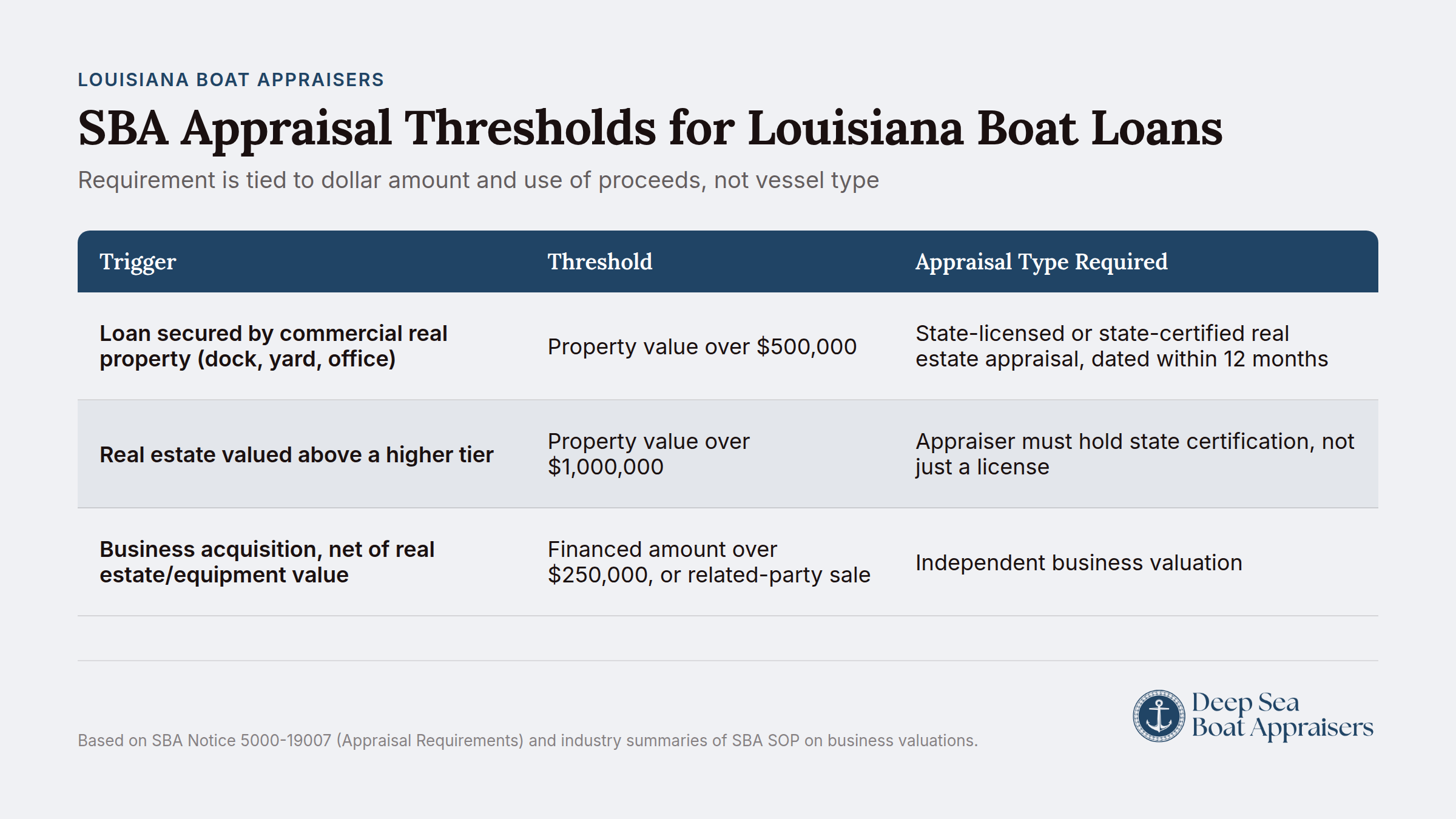
SBA lending rules tie the appraisal requirement to dollar thresholds and to how the loan proceeds are used, not to the type of vessel being financed. Three thresholds come up repeatedly in Louisiana boat financing deals.
| Trigger | Threshold | Appraisal Type Required |
|---|---|---|
| Loan secured by commercial real property (dock, yard, office) | Property value over $500,000 | State-licensed or state-certified real estate appraisal, dated within 12 months of application |
| Real estate valued above a higher tier | Property value over $1,000,000 | Appraiser must hold state certification, not just a license |
| Business acquisition, net of real estate/equipment value | Financed amount over $250,000, or a related-party sale | Independent business valuation |
The $500,000 real estate threshold and the 12-month appraisal age rule both come directly from SBA's published appraisal requirements notice. The $1,000,000 certification tier and the related-party trigger for business valuations are addressed in industry summaries of the SBA's standard operating procedures, including analysis of SBA business valuation requirements.
For most Louisiana fishing and charter boat loans, there's no dock or office building in the deal, so the real estate thresholds rarely apply directly. What matters instead is whether the lender is relying on the vessel's value as collateral. When it is, that reliance itself is usually enough to trigger an independent appraisal requirement under the lender's own underwriting policy, even without a specific SBA line item naming boats.
Fair Market Value or Liquidation Value: Which Definition Does Your Lender Need?
The value definition a lender specifies matters as much as the number itself. Fair market value assumes a willing buyer and willing seller, neither under compulsion, with reasonable exposure time on the open market. Orderly liquidation value assumes a shorter marketing period and a seller under some pressure to sell, which typically produces a lower number than fair market value.
Banks and SBA lenders financing a working vessel often specify orderly liquidation value rather than fair market value, because liquidation value more closely reflects what the lender could actually recover if the loan defaulted and the boat had to be sold quickly. A shrimp boat with a thin secondary market and specialized rigging may see a meaningful gap between its fair market value and its liquidation value; a well-maintained charter boat in a strong recreational market may see a smaller one.
Example: A 65-foot steel shrimp trawler might carry a fair market value of $310,000 given time to find the right buyer, but an orderly liquidation value closer to $220,000 if the lender needed to move it within 90 days. That gap is exactly why the lender specifies which definition it wants before the appraisal begins.
Pro tip: Ask your lender in writing which value definition the appraisal needs to address. Requesting the wrong premise is one of the most common reasons a report gets sent back for revision.
How Commercial Vessels Are Valued: Cost, Sales Comparison, and Income Approaches
Commercial and income-producing vessels, including shrimp boats, charter boats, and workboats, are typically valued using a combination of three approaches rather than a single method.
- Cost approach: Estimates the current cost to reproduce or replace the vessel's hull, engines, and gear, then deducts physical depreciation, functional obsolescence, and, where relevant, economic obsolescence tied to permit or documentation status.
- Sales comparison approach: Analyzes recent sales of similar commercial vessels, adjusted for size, age, engine hours, gear package, and hull material, though detailed sale data on commercial craft is often limited to major statistics rather than full transaction records.
- Income approach: Evaluates the vessel's earning capacity, particularly relevant for charter operations and vessels with documented catch history, by capitalizing the income the boat is capable of producing.
Our appraisers reconcile these approaches into a single supportable conclusion rather than defaulting to whichever number is highest. For a working vessel, the cost and sales comparison approaches usually carry the most weight, with the income approach serving as a check on reasonableness, particularly for charter operations with several years of consistent booking history.
What to Expect During a Loan-Purpose Vessel Appraisal
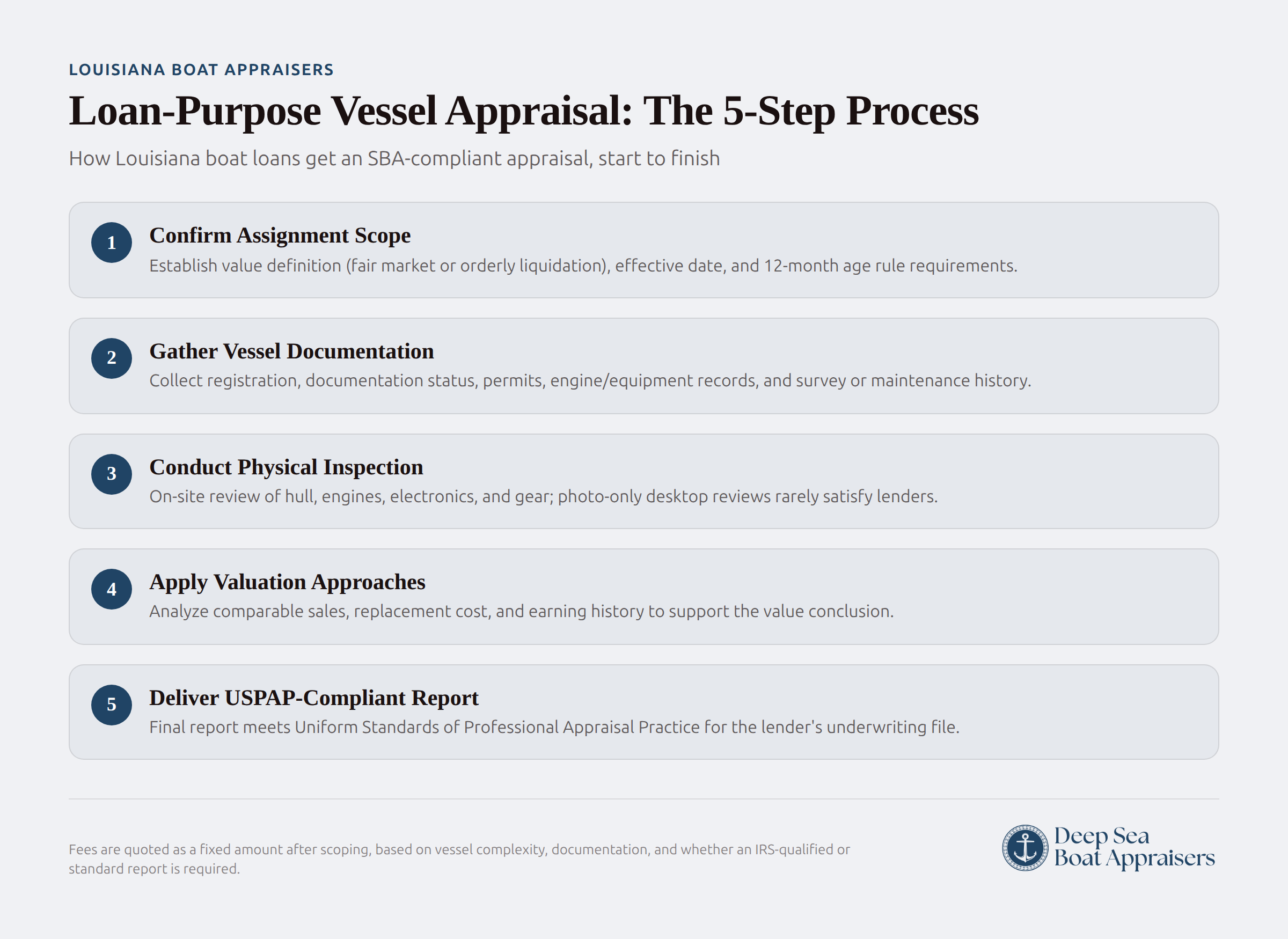
A loan-purpose vessel appraisal follows a defined sequence, and knowing the steps ahead of time keeps a financing deal on schedule.
- Confirm the Assignment Scope with the Lender
- We confirm the value definition the lender needs (fair market value or orderly liquidation value), the effective date required, and whether the report must meet the 12-month age rule at closing.
- Gather Vessel Documentation
- Registration, documentation status, permits, engine and equipment records, and any recent survey or maintenance history get collected before the inspection.
- Conduct the Physical Inspection
- A physical, on-site inspection of the hull, engines, electronics, and gear is standard for commercial vessels; a desktop review based on photos alone typically will not satisfy a lender's collateral requirements.
- Apply the Cost, Sales Comparison, and Income Approaches
- Our appraisers analyze comparable sales, replacement cost, and, where relevant, the vessel's earning history to reach a supportable value conclusion.
- Deliver a USPAP-Compliant Report
- The final report is prepared in accordance with the Uniform Standards of Professional Appraisal Practice, giving the lender documentation that meets its underwriting file requirements.
Engagements are quoted as a fixed fee after we scope the assignment, based on the vessel's complexity, the documentation available, and whether the lender requires an IRS-qualified or standard report format. We never bill by the hour, and we never estimate a fee before understanding what the lender actually needs.
Getting Your Financing Appraisal Right the First Time
A lender's appraisal requirement is not a formality to work around. It is the mechanism that lets a bank or SBA lender extend credit against a vessel it has never seen in person, and getting the scope, the value definition, and the inspection standard right the first time keeps a financing deal from stalling at the closing table. If you are financing a shrimp boat, workboat, or charter vessel anywhere in Louisiana, our Louisiana boat appraisal team can confirm what your lender needs before the inspection is ever scheduled. Request an appraisal to get the process started.
This article is provided for general informational purposes only and does not constitute legal, tax, or financial advice. Readers should consult their lender or a qualified attorney or CPA regarding their specific financing circumstances.