
Blog
Date-of-Death Boat Valuation for a Louisiana Succession: What Heirs Need to Know
A Louisiana succession requires every boat to carry a fair market value as of the decedent's date of death, not a guide number or a later sale price. Here's why a documented date-of-death appraisal protects the succession representative and can double as federal estate tax support if the estate needs it.
If you are serving as the succession representative for someone who owned a boat, you already know the sworn descriptive list asks for a value. What it does not spell out clearly is how exposed you are if that value turns out to be wrong, or why a generic guide number is a weak place to get it. This article walks through what the law actually requires, why a boat specifically needs more than a guess, and how a single, properly dated appraisal can carry the weight of both a succession filing and, for larger estates, a federal estate tax return. For the broader rules on how Louisiana succession law classifies and handles movable property like boats, see our guide to Louisiana succession law and boats. This piece focuses narrowly on the valuation standard itself.
What Louisiana Law Requires From the Sworn Descriptive List
A Louisiana succession representative who files a sworn detailed descriptive list instead of a formal inventory must state each item of succession property, where it is located, and its fair market value as of the decedent's date of death, under Louisiana's succession and inventory provisions. That list is sworn to under oath, which means the representative is personally attesting that the values are accurate.
Here is the detail most heirs miss: the statute does not require a professional appraisal to arrive at that number. A good-faith estimate, made in reasonable reliance on available information, is technically permitted. But the list is only prima facie proof of what it states. That means any heir, creditor, or the court itself can challenge a value on the list, and the burden shifts to the succession representative to defend the number once it is traversed.
For most succession assets, a soft estimate carries limited risk because the values are small or well-documented elsewhere. A boat is different.
Why a Good-Faith Guess Is a Real Risk for a Boat Specifically
Boats depreciate unevenly, and two vessels of the same make, model, and year can be worth very different amounts depending on engine hours, maintenance history, electronics, and hull condition. Along the Gulf Coast, that variance gets wider: a boat's location, storage history, and whether it has ever been exposed to a named storm all move the number in ways a casual estimate will not capture.
A succession representative who signs off on a round-number guess, pulled from memory or from what the decedent once said the boat was worth, is making a sworn statement they may not be able to support later. If an heir disputes the distribution, or if the estate is audited, that guess becomes the representative's problem to defend personally. A documented, dated valuation shifts that burden onto a professional record instead of the representative's own say-so.
Why a NADA-Style Guide Value Falls Short
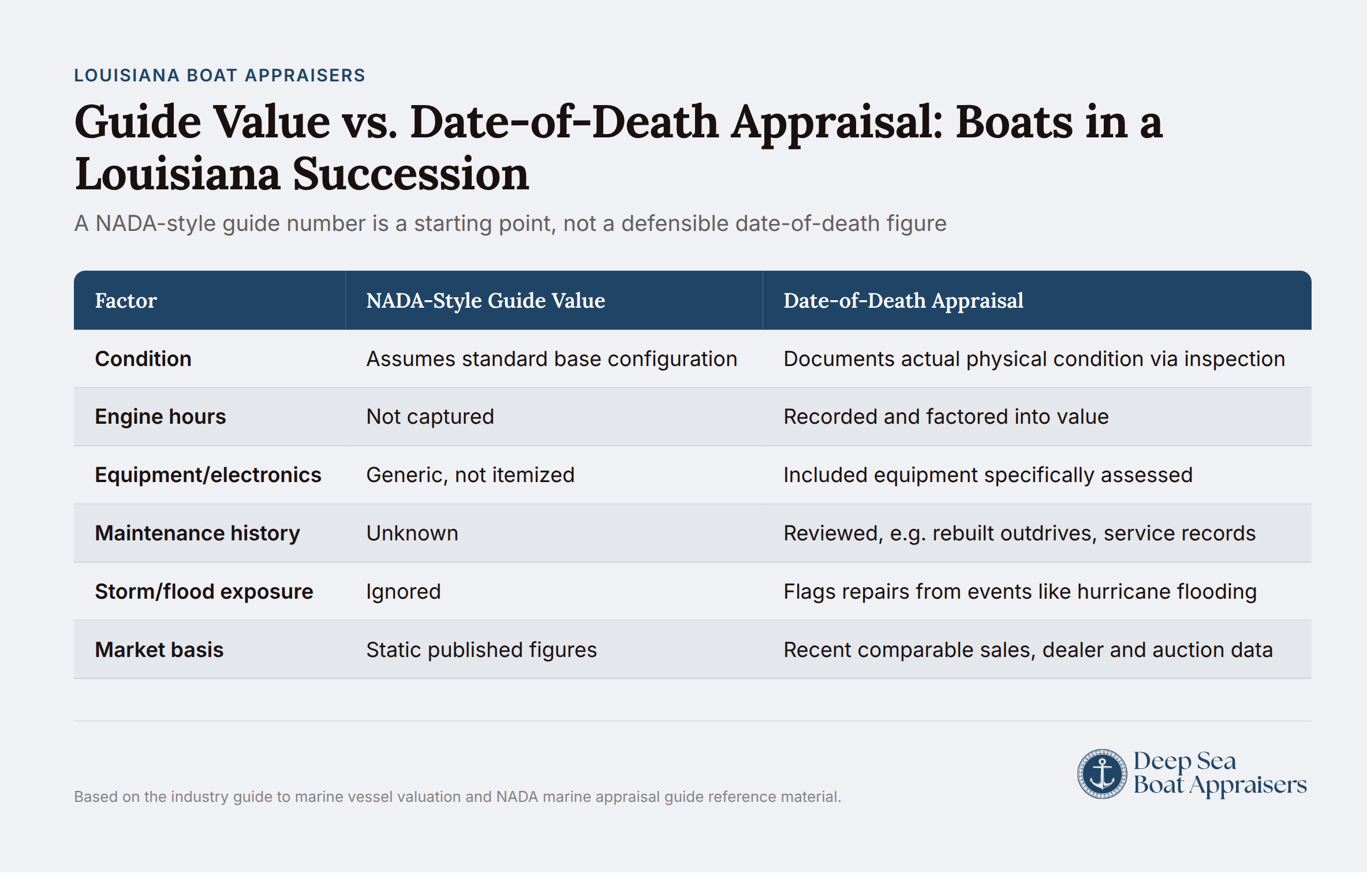
A marine guide value reflects a generic base configuration for a given make, model, and year. It is a starting point, not a finished answer. It does not know the specific boat's engine hours, the condition of its electronics, whether the outdrive was rebuilt last season, or whether the vessel took on water during a hurricane three years ago and was repaired rather than replaced.
Insurers and courts routinely discount guide values for exactly this reason: a guide number cannot account for condition, maintenance records, included equipment, or regional market conditions, and marine valuation practice instead leans on recent comparable sales, dealer and auction data, and a hands-on inspection to arrive at a defensible figure (see the industry guide to marine vessel valuation). Published marine guide references themselves are built around standard configurations and are meant to be adjusted, not quoted as-is (see the NADA marine appraisal guide reference material).
Example: Two identical-model center consoles, both built the same year, can differ by thousands of dollars once one has 400 hours on freshly serviced engines and the other has 900 hours with a documented hurricane-flood history. A guide value treats them the same. A date-of-death appraisal does not.
When Federal Estate Tax Rules Also Come Into Play
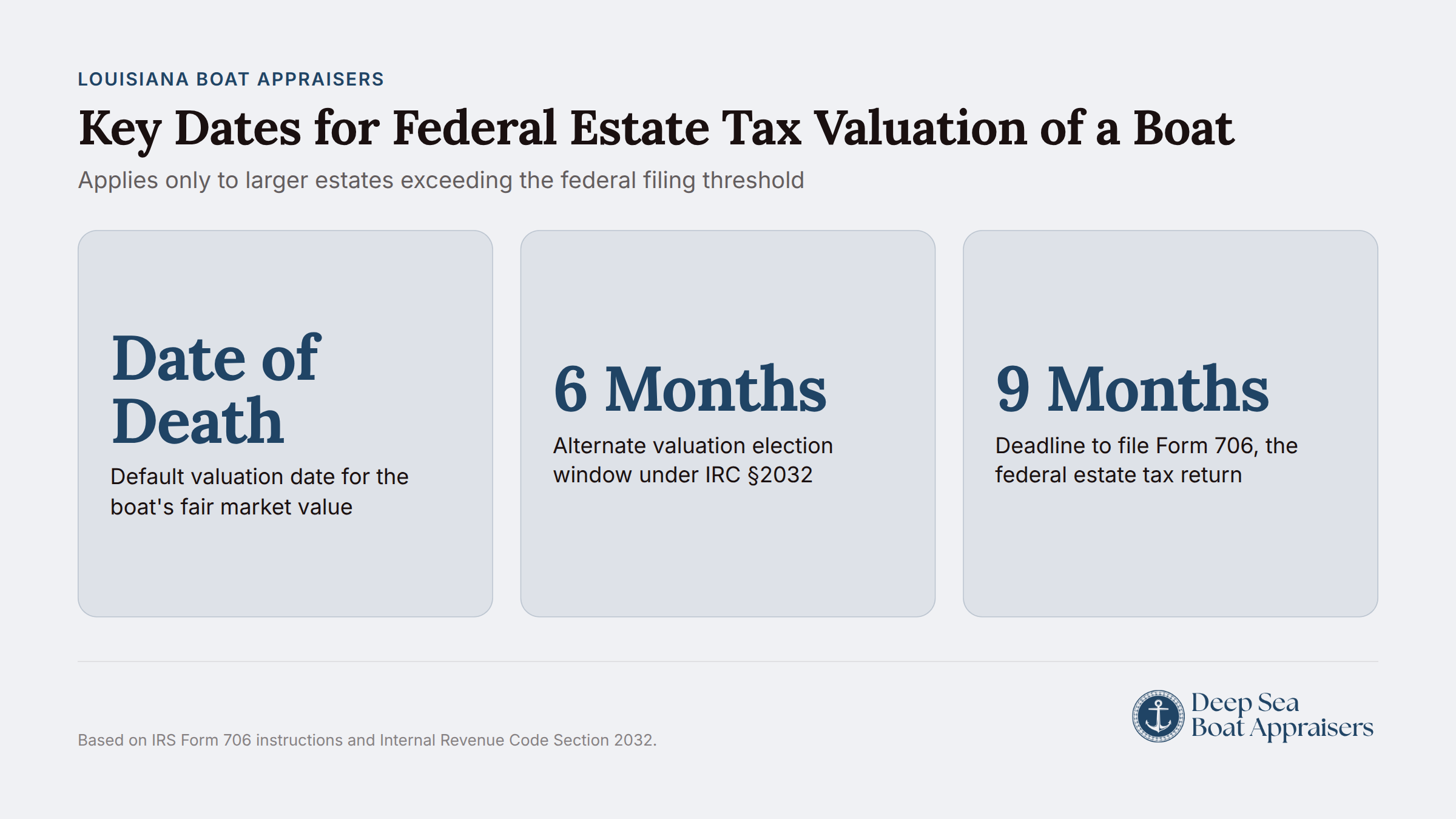
Most boat-owning families never trigger a federal estate tax return. Form 706 is only required when the decedent's gross estate, combined with adjusted taxable gifts, exceeds the federal filing threshold for the year of death, and that threshold is published and adjusted annually by the IRS. For the large majority of successions, this section will not apply.
But for larger estates, it is worth knowing that federal law uses the same fair market value standard: the price at which the property would change hands between a willing buyer and a willing seller, neither being under any compulsion to buy or sell, and both having reasonable knowledge of the relevant facts. The valuation date is ordinarily the date of death, though the Form 706 instructions allow the executor to elect an alternate valuation date, generally six months after death, under Internal Revenue Code Section 2032. If the boat is sold, distributed, or otherwise disposed of during that six-month window, the disposition date generally governs instead. Whether that election makes sense is a decision for the estate's attorney or CPA, not something to default into.
Even when Form 706 is not required, the date-of-death value still matters: an heir who later sells the boat generally inherits it with a basis equal to its fair market value at death, which is the figure used to calculate any later gain or loss (see the IRS guidance on inherited property).
One Appraisal Can Serve Two Purposes
Here is the practical payoff of doing this correctly the first time: a single boat appraisal, prepared effective as of the decedent's date of death and documented with comparable sales and condition detail, can support both the Louisiana sworn descriptive list and a federal Form 706 filing if one turns out to be necessary. There is no need to commission two separate valuations as long as the report is dated correctly and built to the fair market value standard both systems rely on.
This is where scope matters when you request the work. A standard personal property valuation is suitable for most succession filings. If the estate is large enough that a federal return is likely, ask for a report prepared to the IRS-qualified standard from the outset, since it costs little extra to build that documentation in at the time of inspection rather than redoing the work later. Our boat appraisals are quoted as a fixed fee once we understand the vessel and the intended use of the report, never billed hourly.
What a Defensible Date-of-Death Boat Appraisal Documents
A succession representative should expect a proper date-of-death appraisal to include the following:
- Vessel identification: make, model, model year, hull identification number, length, and propulsion type.
- Condition inspection: hull, deck, machinery, electrical systems, and cosmetic condition as observed, with photographs.
- Engine and maintenance records: hours, service history, and any known mechanical issues or recent repairs.
- Included equipment: electronics, trailer, tenders, generators, and any other equipment that travels with the boat.
- Known defects or history: prior damage, liens, or storm exposure that a buyer would reasonably want disclosed.
- Comparable sales data: recent completed sales of similar vessels, adjusted for differences, rather than asking prices alone.
- The effective valuation date: stated explicitly as the decedent's date of death, with later events clearly separated from what existed on that date.
A report built this way gives the succession representative something to point to if a value is ever traversed under the sworn descriptive list process, and it gives the estate's CPA a ready-made record if a federal return becomes necessary.
Get the Valuation Right Before You Sign
The sworn descriptive list is a personal attestation, not a formality. For most succession assets, a careful estimate is low-risk. A boat is not most assets: its value moves on condition, hours, equipment, and regional market history in ways a guide number cannot capture, and the person who signs the list is the one left defending it if a value is challenged. A documented, date-of-death appraisal settles the number once, supports the succession filing, and stands ready if the estate ever needs it for federal tax purposes too.
If you are preparing a sworn descriptive list or succession inventory that includes a boat, you can request an appraisal scoped to exactly what your succession needs.
This article is provided for general informational purposes only and does not constitute legal, tax, or financial advice. Readers should consult a qualified attorney or CPA regarding their specific succession or estate tax circumstances.