
Blog
How to File Louisiana Form R-1331 for Watercraft Sales Tax Certification
Filing Louisiana Form R-1331 correctly is what stands between your new boat and a completed LDWF registration. This guide walks New Orleans-area buyers through every step, the paperwork each sale type requires, and when a professional appraisal belongs in the file.
If you just bought a boat in or around New Orleans, the state won't let the Louisiana Department of Wildlife and Fisheries register it until you've settled the sales tax question. That's the job of Form R-1331, the Watercraft Sales Tax Payment Certification. It tells the Louisiana Department of Revenue that state, parish, municipal, and school board tax has either been paid or isn't owed on your particular transaction, and it's a required stop before LDWF issues a registration certificate.
This guide walks through the filing process step by step, what documentation each type of sale requires, and the situations where a written appraisal of the boat's fair market value genuinely strengthens your paperwork. If you need the boat itself valued before or after the sale, our boat appraisal services cover exactly that kind of documentation.
What Form R-1331 Actually Certifies
Form R-1331 exists because Louisiana law bars LDWF from registering a newly purchased boat until proof of tax payment (or a valid exemption) is on file. The form is how a buyer supplies that proof, whether the boat was bought from a dealer, a private seller, a broker, or brought in from out of state.
A completed R-1331 packet goes to two places: your local parish or municipal taxing authority and LDWF, alongside your boat registration application. Skipping either step is the most common reason a registration stalls at the counter.
Step-by-Step Filing Guide
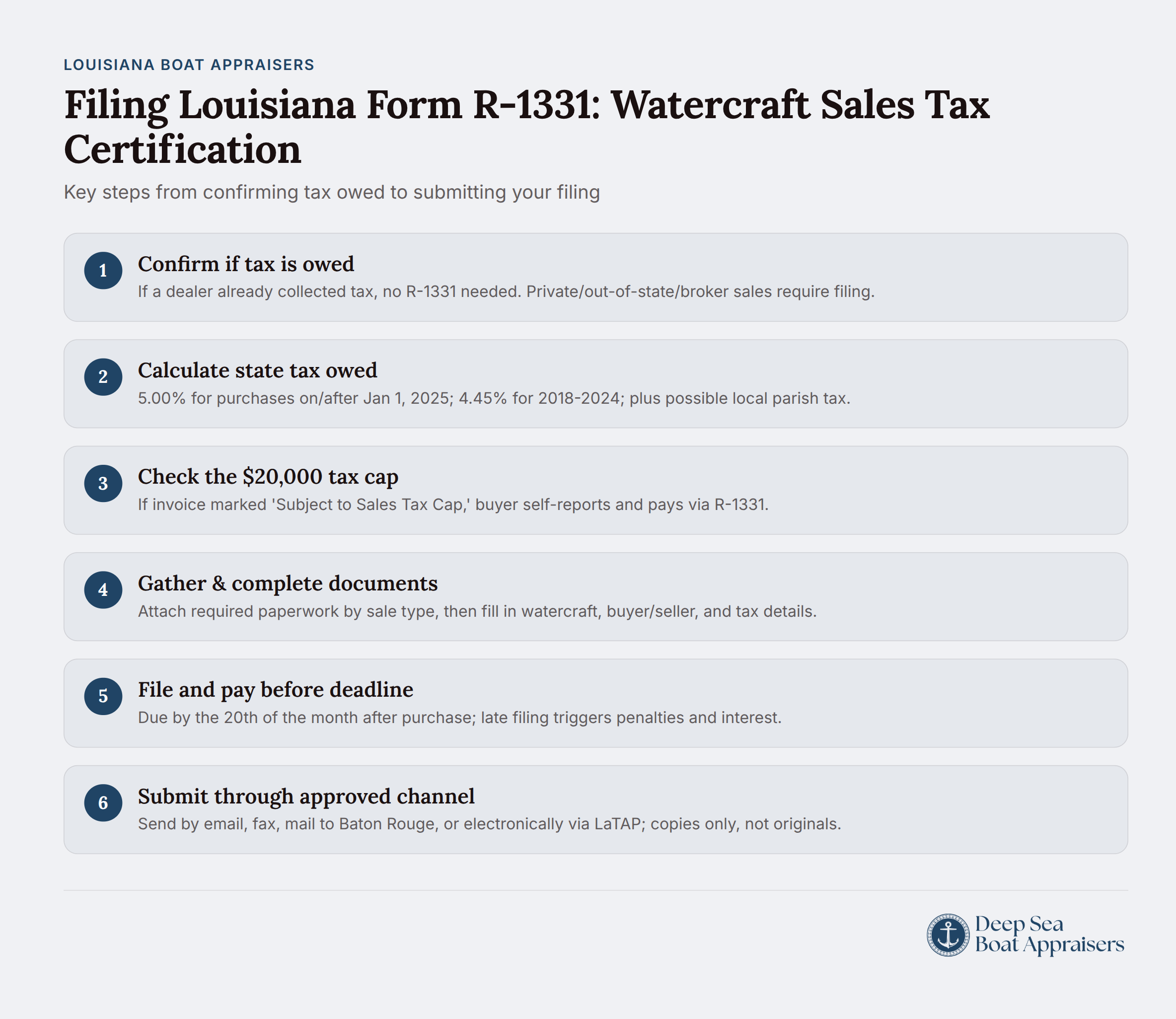
Confirm Whether You Owe Louisiana Sales Tax Start by figuring out whether tax was already collected. If a Louisiana dealer or builder handled the sale and collected tax, you typically don't need to file R-1331 with LDR at all; the dealer's invoice showing the tax paid goes straight into your LDWF registration packet. If tax wasn't collected, whether because the seller was a private individual, an out-of-state dealer, or a broker, you'll need to file.
Calculate the State Tax Owed For watercraft purchased on or after January 1, 2025, the current Louisiana state sales tax rate on boat purchases is 5.00%. Purchases made between July 1, 2018, and December 31, 2024 were taxed at 4.45%, and earlier purchase dates carry their own historical rates listed on the form itself. On top of the state rate, you may owe local sales or use tax to your parish or municipality; LDR generally does not collect that portion directly, though some parishes collect it on LDR's behalf.
Check Whether the $20,000 Tax Cap Applies Louisiana caps the combined state and local sales tax liability on certain boat purchases. When a transaction qualifies, the dealer marks the invoice "Subject to Sales Tax Cap" and the buyer self-reports and pays the applicable tax directly using Form R-1331 rather than paying the uncapped amount at the point of sale. We've covered how that cap works in more detail in our guide to Louisiana's boat sales tax cap under Act 11.
Gather the Right Supporting Documents The documents you attach depend entirely on how you acquired the boat. See the breakdown by sale type below; missing paperwork is the single biggest reason LDR ends up assessing tax on the full purchase price rather than accepting a lower or exempt amount.
Complete Form R-1331 Fill in the watercraft description, buyer and seller information, the transaction details and purchase price, and the tax calculation or exemption basis. LDR publishes an interactive help guide on its site walking through each field if you get stuck.
File and Pay Before the Deadline Sales tax must be reported and paid no later than the 20th day of the month following the month of purchase. A boat bought on September 12, for example, has its R-1331 and payment due October 20. Miss that date and the liability becomes delinquent the next day, which means penalties and interest start accruing.
Submit Through an Approved Channel LDR accepts Form R-1331 by email, fax, mail to the Louisiana Department of Revenue's watercraft sales tax unit in Baton Rouge, or electronically through LaTAP using the "Report Watercraft Purchase" option. Send copies, not originals: LDR does not return submitted documents.
Documentation Requirements by Sale Type
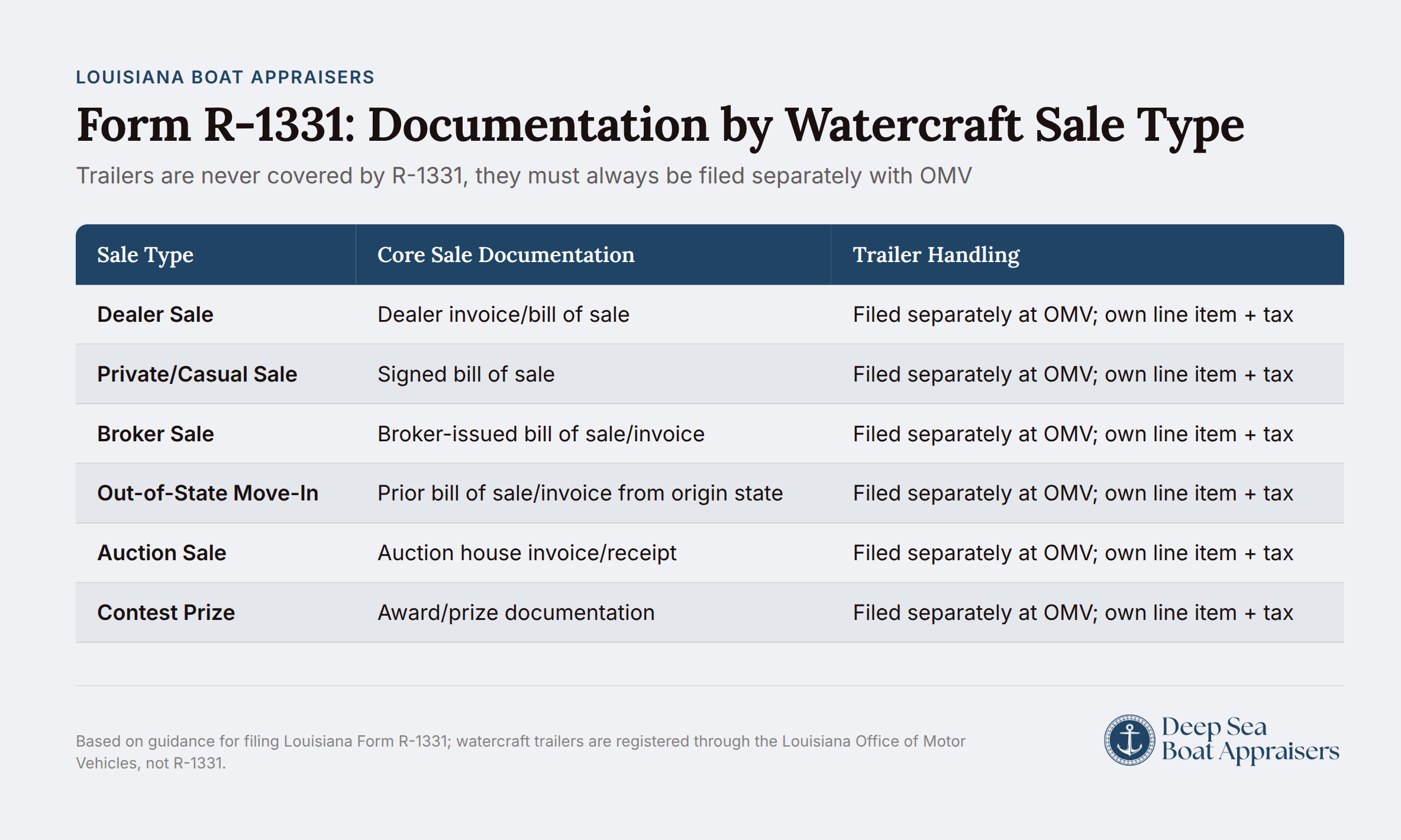
What you attach to Form R-1331 changes depending on who you bought the boat from. Getting this part wrong is what causes LDR to fall back on the full purchase price for tax purposes instead of recognizing an exemption or a lower assessed value.
| Sale Type | Required Documentation |
|---|---|
| Dealer or builder | Invoice or bill of sale showing tax paid, with boat, motor, and trailer taxed and itemized separately |
| Private or casual seller | Bill of sale plus a copy of the prior owner's title or the LDWF registration certificate signed over to the buyer |
| Broker sale (isolated/occasional) | Canceled check, bill of sale or signed-over registration certificate, plus proof the seller wasn't in the business of selling watercraft |
| Out-of-state move-in | Prior state title or registration; tax assessed on the lower of cost or fair market value at time of entry into Louisiana |
| Auction purchase | Bill of sale showing tax paid |
| Contest prize | Bill of sale plus proof that tax was already paid |
A few of these categories deserve more explanation.
Private and Casual Sales: Watch This One Closely
Here's a detail that trips up a lot of New Orleans-area buyers: if you bought your boat from an individual who wasn't in the business of selling watercraft, there's currently no Louisiana state sales tax owed on that isolated or occasional sale at all. But you still have to file Form R-1331 and supply the bill of sale and prior title to certify that fact to LDR before LDWF will register the boat. Skipping the paperwork doesn't mean you owe less tax; it means your registration simply doesn't move forward.
The line between a genuine casual sale and a dealer sale matters here too. If the seller regularly buys and resells boats, even informally, that transaction doesn't qualify as isolated or occasional, and different rules apply.
Broker Sales Have Four Specific Tests
A broker-facilitated sale only qualifies as isolated or occasional if all four conditions hold: the seller isn't in the business of selling watercraft, there's no pattern of frequent repeat sales, the seller held title or possession of the boat, and the seller originally bought it for personal use. Buyers in this category need to submit a canceled check alongside the bill of sale or signed-over registration certificate.
Trailers Are Filed Separately
One easy mistake: watercraft trailers are not part of Form R-1331 at all. A trailer gets registered separately through the Louisiana Office of Motor Vehicles, and if one was included in your purchase, it needs to appear as its own line item on the bill of sale or invoice with its own tax figure.
When a Professional Appraisal Belongs in Your R-1331 Packet
A written appraisal isn't part of the standard R-1331 checklist, but there are three situations where one becomes genuinely useful documentation rather than an extra expense.
You moved the boat into Louisiana from another state. LDR assesses tax on the lower of the original purchase cost or the boat's fair market value at the time it entered Louisiana. If the boat has depreciated, been upgraded, or its documented cost is unclear, a dated fair market value appraisal gives LDR a defensible number to work from instead of an estimate.
There's no clean bill of sale, or the price is disputed. Private sales sometimes happen on a handshake, with a bill of sale written after the fact or a price that doesn't match what either party remembers. A USPAP-compliant appraisal establishes an independent, documented value that supports whatever figure goes on the R-1331 form.
The boat came as a gift, inheritance, or prize. None of these transfers involve an arm's-length purchase price, which is exactly what LDR's forms are built around. An appraisal fills that gap with a defensible fair market value tied to the date of transfer.
Our appraisers prepare boat valuations in accordance with the Uniform Standards of Professional Appraisal Practice, the standard published by the Appraisal Foundation and referenced across the personal property appraisal field. Fees are quoted as a fixed amount after we scope the boat, its documentation, and the intended use of the report, never billed by the hour. If you're weighing whether an appraisal makes sense for your situation, our team can help you request an appraisal and talk through what your R-1331 filing actually needs.
Two Deadlines, Not One
It's easy to conflate the tax deadline with the registration deadline, but they're separate clocks. Sales tax on your R-1331 filing is due by the 20th day of the month following your purchase month. Separately, LDWF generally expects an application to title and register a newly purchased boat within 15 days of the purchase date. Missing either one creates its own headache: a late tax filing brings penalties and interest, while a late registration application can leave you operating an unregistered vessel.
If you bought your boat out of state and Louisiana's tax rate turns out higher than what you already paid, don't be surprised by a follow-up letter. LDR reviews the paperwork you submit, calculates the difference, and sends notice of any additional amount due along with payment instructions.
Keep the Paper Trail Complete
Form R-1331 is a short form, but the documentation behind it is what actually gets your boat registered. Match your paperwork to your sale type, watch the 20th-of-the-month deadline, and don't assume a private sale means no filing is required. When the sale price, entry value, or ownership history isn't crystal clear on paper, a professional appraisal is often the cleanest way to give LDR and LDWF a number they can accept without back-and-forth.
This article is provided for general informational purposes only and does not constitute legal, tax, or financial advice. Readers should consult a qualified attorney or CPA regarding their specific circumstances.