
Blog
How the 2025 Louisiana Boat Sales Tax Cap Changes What Gulf Coast Buyers Owe
Louisiana now caps combined state and local sales tax on a registered boat at $20,000, but the math only helps buyers above a certain price point. Here is how the cap actually works for a New Orleans or Lake Pontchartrain purchase, and what documentation you need to claim it.
If you are shopping for a boat in the New Orleans or Lake Pontchartrain area after July 1, 2025, Louisiana's new sales tax cap changes the math on higher-priced purchases, but not the way most buyers assume. The cap does not lower the tax rate. It limits the total dollar amount of tax you owe, and only once your purchase crosses a certain price threshold. This guide breaks down what the cap covers, what counts toward it, and what paperwork a Gulf Coast buyer needs to actually claim the benefit. For a broader look at the law itself, see our detailed rundown of Act 11.
What the Louisiana Boat Sales Tax Cap Actually Caps
Act 11 of the 2025 Third Extraordinary Session created a partial sales tax exemption, now codified at La. R.S. 47:305.23, that caps combined state and local sales and use tax on a boat registered in Louisiana at $20,000. The cap applies when the tax is paid within 90 days of purchase or importation into the state, and it took effect July 1, 2025, according to the Louisiana Department of Revenue's cap guidance.
The underlying bill, described in the Louisiana Legislature's official digest, was written to keep large vessel purchases and registrations from drifting toward Florida and Texas, both of which have had similar boat tax caps for years. Louisiana's general state sales tax rate on boats is 5%, and parish and municipal taxes stack on top of that. The combined rate that actually matters for the cap math varies by parish, which is why the cap does not kick in at the same purchase price everywhere in the state.
How Much Tax Do You Actually Owe?
The short answer: if your combined state and local tax liability on the boat itself would be $20,000 or less, the cap does nothing for you. You pay what you would have paid anyway. The cap only changes your bill once the uncapped liability crosses $20,000.
Using a commonly cited combined rate of roughly 10% (5% state plus a representative local rate), the breakeven point lands around $200,000 in boat price. That $200,000 figure is not written into the statute; it is simply the price at which a 10% combined rate produces exactly $20,000 in tax. A parish with a higher local rate reaches the cap at a lower price, and a parish with a lower local rate reaches it later.
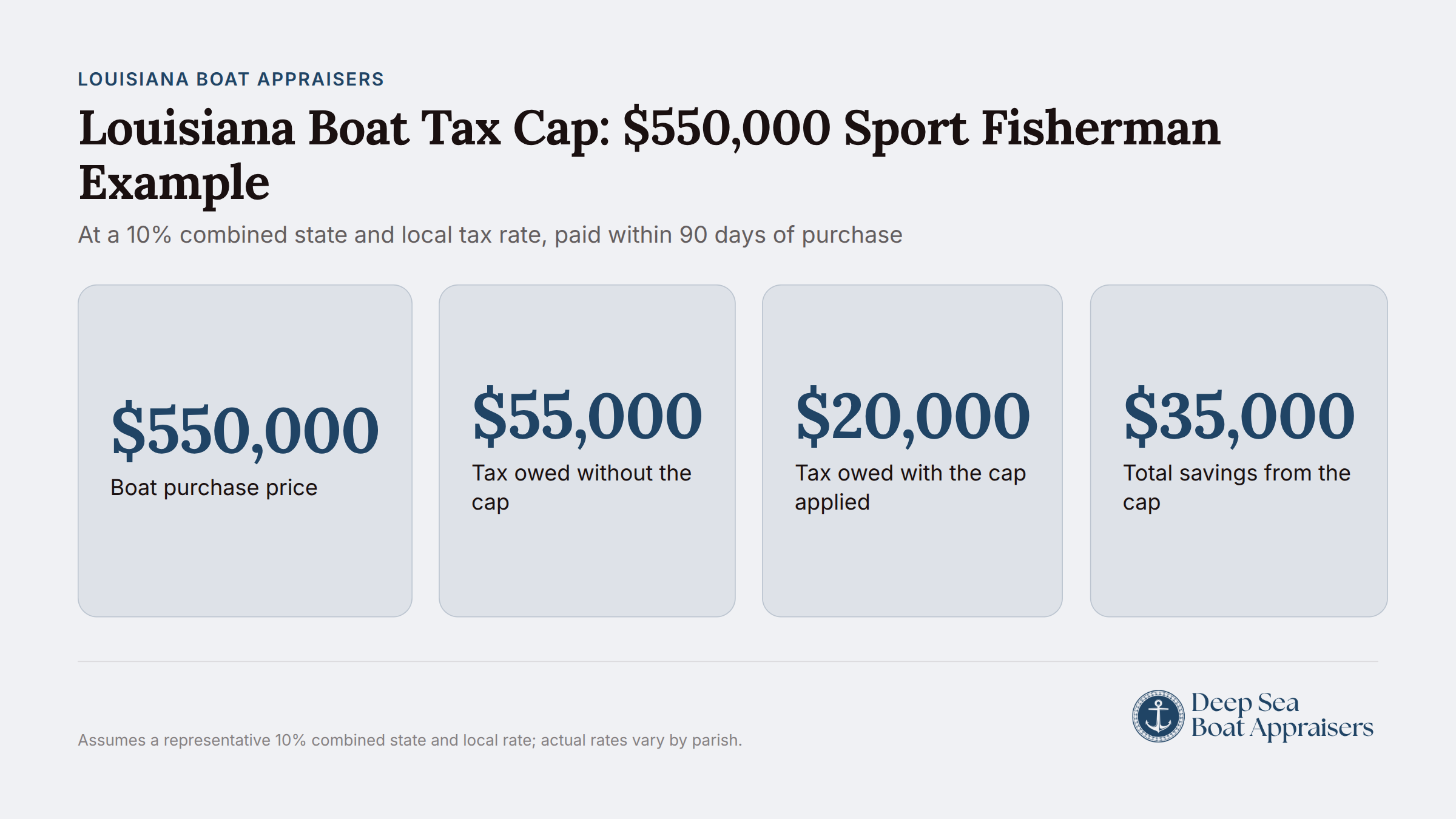
Example: A buyer purchases a $550,000 sport fisherman and registers it in a parish with a 10% combined state and local rate. Without the cap, the tax bill would be $55,000. With the cap in place and the tax paid within 90 days of purchase, the buyer owes $20,000 instead, a savings of $35,000.
| Boat price | Tax at a 10% combined rate | Tax owed under the cap |
|---|---|---|
| $100,000 | $10,000 | $10,000 (no cap benefit) |
| $200,000 | $20,000 | $20,000 (breakeven) |
| $300,000 | $30,000 | $20,000 |
| $550,000 | $55,000 | $20,000 |
| $1,000,000 | $100,000 | $20,000 |
For most center console and mid-size recreational buyers on Lake Pontchartrain and the surrounding marinas, this changes nothing. If your boat's uncapped tax liability was already under $20,000, you were never going to hit the ceiling in the first place.
What Counts Toward the $20,000 Threshold
One detail trips up buyers more than any other: not everything on the invoice counts toward the price used to test the $20,000 cap. Louisiana Department of Revenue guidance clarifies that only accessories physically attached to the boat at the time of purchase are included in the sales price tested against the threshold.
Items that stay outside that calculation, and remain separately taxable at the ordinary, uncapped rate, include:
- Loose accessories such as ladders, anchors, rod holders, and fish finders sold apart from the hull
- General gear including gas cans, fishing poles, wake boards, life jackets, fire extinguishers, flares, dock line, and boat covers
- Trailers, which are taxed as a separate item regardless of the boat's price
This distinction matters when a dealer bundles a large accessory package into a boat sale. According to Louisiana Department of Revenue clarifications on the cap's mechanics, a buyer and dealer should separate the price of items attached to the vessel from the price of loose gear and trailers on the invoice, since only the former is tested against the $20,000 cap.
How and When to Pay: The Form R-1331 Process
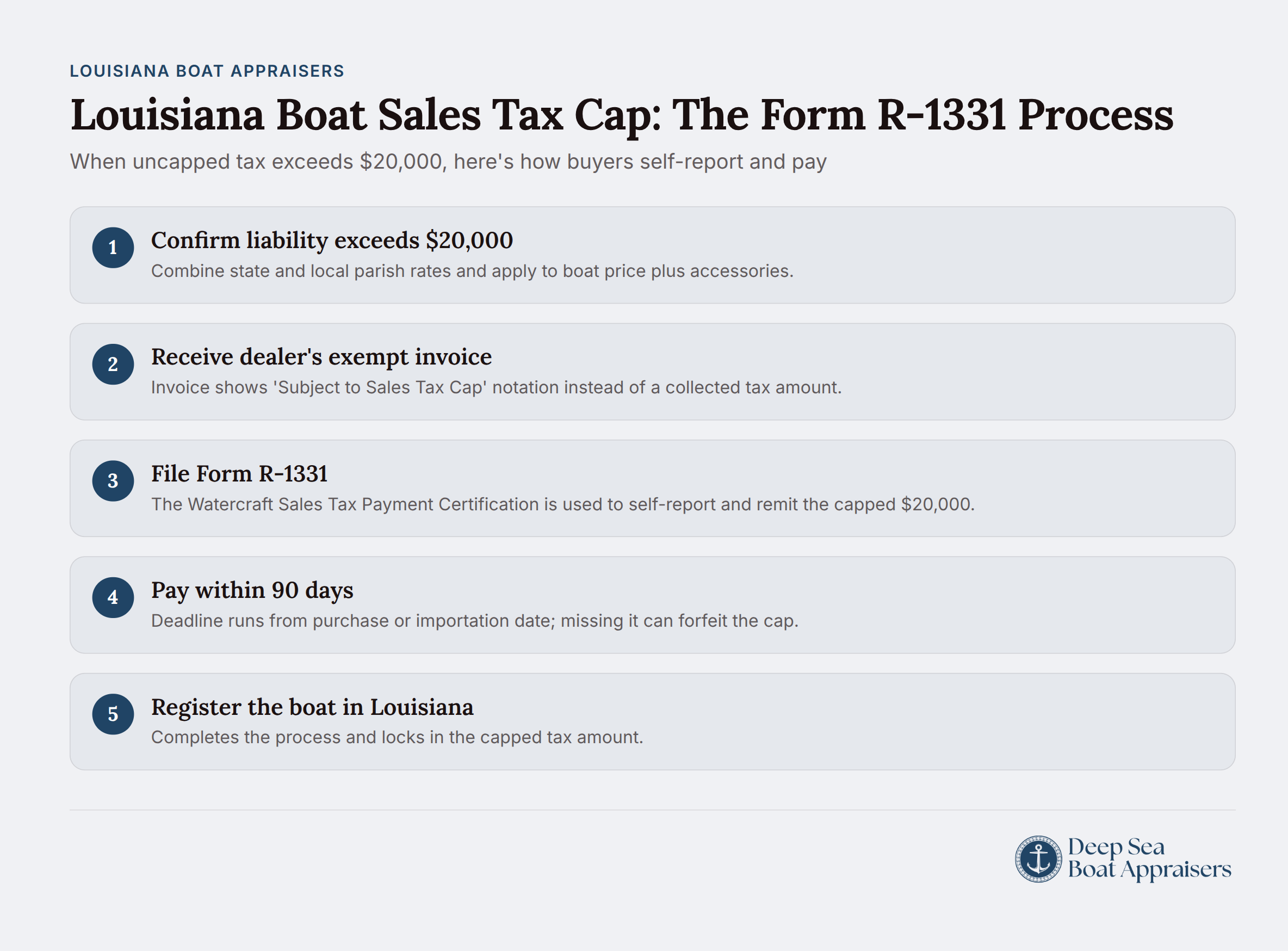
If the tax on the boat itself would exceed $20,000, a Louisiana dealer should not collect sales tax at the point of sale. Instead, the dealer marks the invoice "Subject to Sales Tax Cap" and reports the sale as exempt under the appropriate schedule. The buyer then carries the payment obligation directly.
- Confirm the uncapped liability exceeds $20,000. Work out the combined state and local rate for the parish where the sale is sourced, and apply it to the price of the boat and any attached accessories.
- Wait for the dealer's exempt invoice. The invoice should show the cap notation rather than a collected tax amount.
- File Form R-1331, the Watercraft Sales Tax Payment Certification. This is how you self-report and remit the capped $20,000 directly to the state.
- Pay within 90 days of the purchase or importation date. Missing this window can forfeit the cap, so treat the deadline as firm.
- Register the boat in Louisiana to complete the process and lock in the capped amount.
Buying Out of State? The Reciprocity Credit Comes First
Buyers in the New Orleans area often shop across state lines, and Louisiana allows a credit against its use tax for sales tax already paid to another state on the same boat. That credit is applied before the $20,000 cap, not after. If the other state's tax was lower than what Louisiana would charge, additional Louisiana tax is due on the difference, and only that remaining Louisiana liability gets tested against the cap.
Buyers relying on this credit need to retain the other state's invoice or proof of payment and submit it alongside Form R-1331. If you moved to Louisiana from another state and brought a boat with you, the state taxes you on the lower of the boat's original cost or its fair market value at the time it entered Louisiana, which is a separate valuation question from the cap itself.
Isolated Sales Between Individuals
A private, individual-to-individual sale (not through a dealer) currently owes no Louisiana state sales tax if the seller qualifies for isolated-sale treatment: not in the business of selling boats, no pattern of frequent boat sales, and the boat was held and used by the seller before the sale. Buyers in this situation should document the transaction with a bill of sale and a transfer of the prior owner's title or registration.
Watch out: an isolated sale still needs to establish a defensible value if the transaction is ever questioned, particularly on a higher-value vessel. A bill of sale alone states what was paid; it does not always hold up as an independent valuation if the state or a lender asks how that number was reached.
Where You Live Matters: Sourcing Rules for New Orleans-Area Buyers
For boats purchased in Louisiana, the sale is sourced to the parish where the sale took place. For boats imported into Louisiana from elsewhere, sourcing follows the parish where the purchaser resides. This distinction matters for Orleans Parish and Lake Pontchartrain buyers who cross into a neighboring parish, such as Jefferson or St. Tammany, to close a deal. The local rate that applies to your purchase, and therefore the price point at which the cap actually helps you, depends on which parish's rate governs the transaction, not simply where you live day to day.
Why a Professional Appraisal Supports Your Tax Filing
Most of the paperwork around the cap, the reciprocity credit, and isolated sales comes down to establishing a defensible number: what the boat is actually worth, or what was actually paid for it. Our appraisers prepare purchase price documentation and fair market value reports that support a Form R-1331 filing, particularly in two situations that come up often for Gulf Coast buyers.
The first is an out-of-state purchase where the reciprocity credit depends on an accurate comparison between what was paid elsewhere and what Louisiana would otherwise charge. The second is an isolated sale between individuals, where a simple bill of sale may not hold up as independent evidence of value if the transaction is reviewed. A USPAP-compliant report from a credentialed appraiser gives you a defensible record beyond a handshake price. Reports are quoted as a fixed fee, scoped to the vessel and the documentation involved, before any work begins; our standard boat appraisals start at $195, with advanced, IRS-qualified reports starting at $295.
If you are working through the numbers on a purchase and want to see how appraisal typically fits into that process, our guide on getting a boat professionally appraised in Louisiana walks through what a report includes and how long it takes.
Getting the Cap Right the First Time
The $20,000 cap is a meaningful change for anyone buying a boat priced well above $200,000 in a typical parish, but it rewards buyers who get the mechanics right: separating attached accessories from loose gear, hitting the 90-day payment window, and applying any out-of-state credit before testing the cap. Louisiana plans to adjust the $20,000 figure for inflation starting July 1, 2030, so today's breakeven math will shift over time.
If you are weighing a purchase on Lake Pontchartrain or anywhere along the Gulf Coast and need documentation to support your Form R-1331 filing, request an appraisal from our team before you close.
This article is provided for general informational purposes only and does not constitute legal, tax, or financial advice. Readers should consult a qualified attorney or CPA regarding their specific circumstances.