
Blog
Does Louisiana Charge Sales Tax on a Private Boat Sale Near Lake Pontchartrain?
Louisiana generally does not tax a casual, one-time boat sale between private individuals, but the rules change fast if the seller resells boats regularly or works through a broker. Here is how buyers near Lake Pontchartrain can tell which rule applies and protect themselves if the sale price is ever questioned.
If you are buying a used boat from a private owner around Lake Pontchartrain, one of the first questions you will run into is whether Louisiana expects sales tax on the deal. The short answer is that most private, one-time boat sales in Louisiana are not taxed at the state level. But that exemption only applies under specific conditions, and misunderstanding them can leave a buyer scrambling at registration time or exposed to a tax bill they did not expect.
This guide walks through what counts as a tax-free casual sale, who falls outside that protection, and why a written appraisal can matter more than most buyers realize when a sale price gets questioned later. If you are weighing whether to have the boat itself professionally valued before or after the purchase, our boat appraisal guide walks through how that process works.
The Casual Sale Rule: What Qualifies as Tax-Free in Louisiana
Currently, Louisiana does not charge state sales tax on an isolated or casual sale of a boat between two individuals, provided the seller is not in the business of selling watercraft, according to the Louisiana Department of Revenue's watercraft sales tax FAQ. The department's own example is almost exactly the scenario a Lake Pontchartrain buyer is likely to face: a private owner selling a boat they no longer use.
The key word is isolated. A single owner selling a single boat they personally used, to a single buyer, is the textbook casual sale. Nothing about proximity to Lake Pontchartrain or any other body of water changes this analysis; the exemption is about the nature of the transaction and the seller's business activity, not geography.
What the casual sale exemption does not do is eliminate the paperwork. Even when no tax is owed, Louisiana's registration process still requires documentation proving the transaction qualifies, and the Louisiana Department of Wildlife and Fisheries will not complete a title transfer without it.
Who Is Not Exempt: Dealers, Consignors, and Repeat Sellers
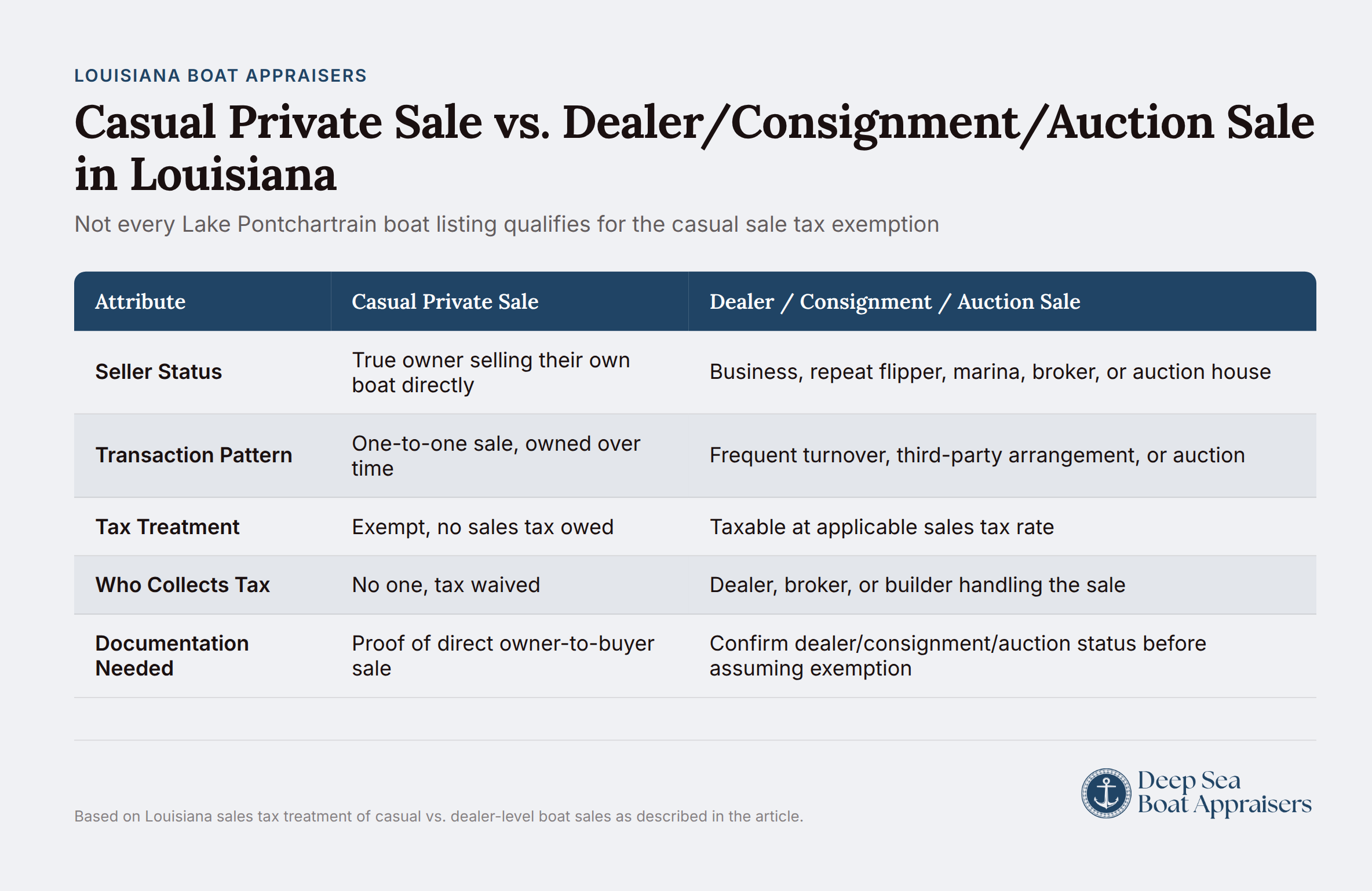
A seller loses casual sale treatment the moment they start looking like a business, even informally. If a seller periodically buys boats to resell, Louisiana sales tax law treats that activity as dealer-level commerce, and the sale becomes taxable at the applicable sales tax rate regardless of whether the seller has a storefront or a dealer license.
This matters for buyers near Lake Pontchartrain because the private resale market there is active, and it is not always obvious from a listing whether you are dealing with a true private owner or someone running an informal flipping operation. A few patterns should raise the question:
- Frequent turnover: The seller has bought and sold multiple boats in a short span rather than owning one boat for personal use over time.
- Consignment arrangements: The boat is being sold through a marina, broker, or dealer acting on the owner's behalf under a consignment agreement.
- Auction sales: The transaction happens through a boat auction rather than a direct owner-to-buyer sale.
Consignment and auction sales are treated as dealer or retail sales under Louisiana law, which means tax is collected by the dealer or builder handling the transaction, not waived as a casual sale. If you are buying through any arrangement other than a direct, one-to-one sale with the titled owner, assume tax applies until you confirm otherwise.
Does Using a Broker Change Anything?
Using a broker to help list or negotiate a sale does not automatically disqualify it from casual sale treatment, but only if several conditions hold at the same time. The seller cannot hold themselves out as being in the business of selling boats, cannot have a history of frequent or repeated boat sales, must maintain title or possession of the boat until the sale closes, and must have originally purchased the boat for personal use rather than resale.
In practice, this means a one-time owner who hires a broker to help find a buyer for their personal boat can still qualify for the casual sale exemption. A person who routinely uses a broker to move boats they acquire for resale cannot. The presence of a broker is not the deciding factor; the seller's underlying pattern of activity is.
Example: A retired charter captain near Lake Pontchartrain sells the one boat he has owned and used personally for 12 years, using a local broker to find a buyer. That is still a casual sale. If the same broker is representing a seller who has moved three different boats through private sales in the last two years, the transaction looks a lot more like dealer activity, and a buyer should ask more questions before assuming no tax is due.
Documenting the Sale: What Buyers and Sellers Must Keep
Even a legitimate casual sale needs a paper trail. Louisiana statute requires buyers to be able to produce documentation such as a canceled check from buyer to seller along with a bill of sale showing the transfer of title, or alternatively the prior owner's certificate of registration showing the ownership transfer, as described in Louisiana's sales tax statute on isolated sales. Without that documentation, a buyer can find themselves unable to prove the sale qualified as casual rather than taxable.
For registration, the Louisiana Department of Wildlife and Fisheries requires a completed boat registration or title application, a bill of sale that lists the hull identification number, make, model, and year, and signatures from both the buyer and seller. If the boat is titled, the seller must surrender that title as part of the transfer.
Watch out: A handshake deal with a cash payment and no bill of sale is the single most common way buyers near Lake Pontchartrain end up stuck at registration. Even when no tax is owed, you still need the documents LDWF and the Department of Revenue expect to see.
The mechanics of actually filing the required tax certification form with the state are a separate process from the casual sale question itself; our guide to filing Louisiana's watercraft tax form covers that in detail.
Protecting Yourself When the Sale Price Is Questioned
A casual sale exemption depends on the transaction being what it appears to be, and part of that is an honest sale price. If a bill of sale lists a price that looks unusually low for the boat's age, make, and condition, a taxing authority or a skeptical party down the line (an insurer, a lender, or even the other party in a dispute) can question whether the stated price reflects what was actually exchanged.
This is where a written, independent appraisal earns its keep. An appraisal establishes the boat's fair market value as of the transaction date using a methodology separate from whatever number appears on the bill of sale. For the buyer, that documentation protects against a later claim that the boat was worth significantly more than what the paperwork shows. For the seller, it supports their own tax reporting and shows the declared price was reasonable, not an attempt to understate value.
Key takeaway: A bill of sale proves a transaction happened and at what stated price. An appraisal proves what the boat was actually worth. Buyers near Lake Pontchartrain making a private purchase benefit from having both, especially on higher-value vessels where a dispute over value is more likely to matter.
Our appraisers prepare valuations for exactly this situation, and fees are quoted as a fixed amount after scoping the assignment rather than billed hourly. For a standard boat appraisal, fees typically start at $195, with IRS-qualified reports starting at $295; more complex vessels run higher depending on research depth and documentation required. You can see how the process works and what a report includes on our request an appraisal page.
What This Means for a Lake Pontchartrain Buyer
For most buyers purchasing directly from a private owner who has used and owned the boat personally, no state sales tax is currently due, and the transaction qualifies as a casual sale. The moment a broker, consignment arrangement, auction, or a pattern of repeat sales enters the picture, that assumption needs to be verified rather than taken for granted.
Keep the documentation the state and LDWF require, confirm the seller's history before assuming casual sale treatment applies, and consider an independent appraisal when the sale involves a higher-value vessel or any disagreement about what the boat is actually worth. None of this is complicated, but skipping it is exactly how buyers end up with registration delays or tax questions months after the deal closes.
This article is provided for general informational purposes only and does not constitute legal, tax, or financial advice. Readers should consult a qualified attorney or CPA regarding their specific circumstances.